
The Peace of Westphalia: how Münster and Osnabrück reshaped Europe in 1648
In October 1648 two treaties ended the Thirty Years' War. The Peace of Westphalia redrew borders, regulated relations between denominations and shaped the Holy Roman Empire until 1806.
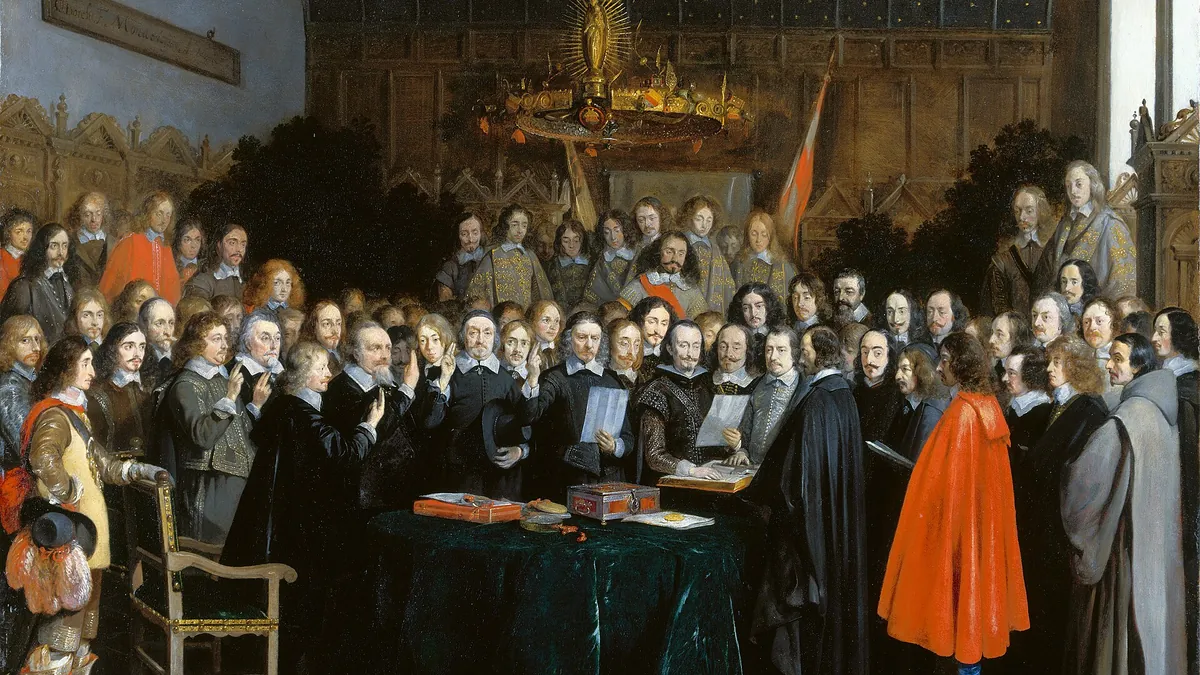
Photo: Gerard ter Borch / Wikimedia Commons, Public domain (cropped and resized)
On 24 October 1648, two peace treaties were signed in Westphalia, negotiated in Osnabrück between Emperor Ferdinand III, Queen Christina of Sweden and their allies, and in Münster between the emperor, King Louis XIV of France and their allies. They ended the fighting that had begun with the Bohemian conflict of 1618.
The peace redrew the map. France gained rights in Alsace and was confirmed in possession of Metz, Toul and Verdun. Sweden received Western Pomerania, Wismar, Bremen and Verden among other lands, giving it control of the mouths of the Oder, Elbe and Weser. Brandenburg gained Eastern Pomerania and the reversion of Magdeburg, while Bavaria kept the Upper Palatinate and its electoral title. The Dutch Republic and the Swiss Confederation were recognised as independent.
The treaties also marked a religious turning point: the Peace of Augsburg of 1555 was confirmed and extended to the Reformed (Calvinists), and 1624 was fixed as the "standard year" for church property and confessional status. Imperial cities gained a seat and vote in the Reichstag, whose consent the Empire's foreign policy now required. The settlement remained a fundamental law of the Holy Roman Empire until its end in 1806.