
Stamp-sized glass chip links telescopes into one large instrument
A glass chip just a few centimetres across has combined light from two telescopes at the CHARA Array in California for the first time. The CHARIOT instrument also detected stars its predecessor could not reach.
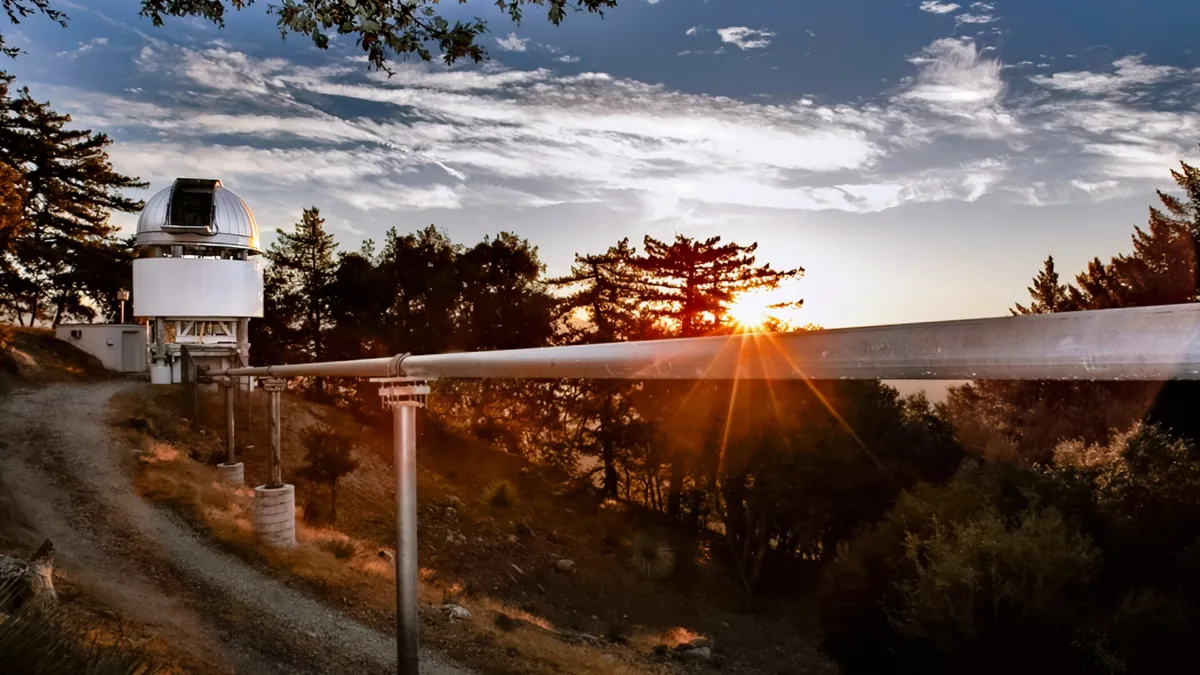
Archive image · Photo: NOIRLab/NSF/AURA / Wikimedia Commons, CC BY 4.0 (cropped and resized)
Astronomers link several telescopes so they act like a single, much larger instrument. Until now this has required elaborate optical set-ups. Researchers at Heriot-Watt University in Scotland and the Leibniz Institute for Astrophysics Potsdam have shown that a glass chip only a few centimetres in size can do the job. The study, led by first author Dr Aline Dinkelaker, appeared in the Monthly Notices of the Royal Astronomical Society (DOI 10.1093/mnras/stag1745); Heriot-Watt presented it on 27 October.
Light-guiding channels are written into the chip with ultrafast laser pulses. It was tested in the CHARIOT instrument at the six-telescope CHARA Array on Mount Wilson in California, during observations in 2024 and 2025 in the infrared around 2.2 micrometres. CHARIOT detected signals from fainter stars than the previous system; for bright and moderately bright stars, however, the predecessor JouFLU was in part still more precise, according to ingenieur.de. Chips can be swapped within a few hours to test new designs.
"This is a significant milestone for a research programme that began more than 15 years ago," says Professor Robert Thomson of Heriot-Watt University. The universities of Cologne and Potsdam and Georgia State University, which operates the CHARA Array, were also involved. In the longer term, the team is examining whether the instrument can be extended from two to four telescopes. The university sees applications such as studying how planetary systems form.