
Model: More snow and clouds could slow the melting of East Antarctica's ice
According to a simulation in Nature Climate Change, the East Antarctic Ice Sheet stays largely stable even with more than 10 degrees of warming – unlike West Antarctica and Greenland.
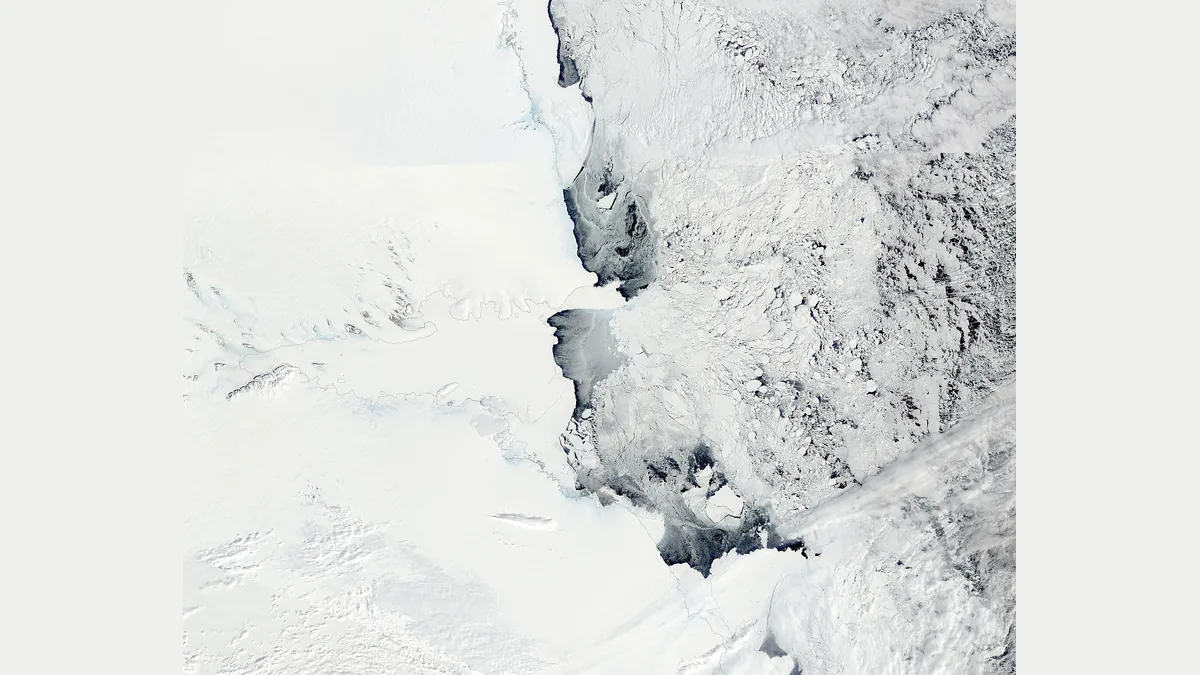
Symbolic image · Photo: MODIS Land Rapid Response Team, NASA GSFC / Wikimedia Commons, Public domain (cropped and resized)
Researchers at the Center for Climate Physics of South Korea's Institute for Basic Science (IBS) in Busan have used a computer model to calculate how ice sheets respond to long-term warming. The study by lead author Yun Kyung-Sook and center director Axel Timmermann was published on October 30 in Nature Climate Change. What is new is that climate and ice sheets evolve together in the model over 100,000 years, instead of the atmosphere and ocean being prescribed from outside.
According to the simulations, West Antarctica loses large amounts of ice under sustained warming of more than about 2 degrees above pre-industrial levels, and Greenland disappears completely above about 6 degrees. East Antarctica remains comparatively stable even above 10 degrees: warmer air carries more moisture, which falls as snow in the interior, and more clouds reduce sunlight and melting. Under the strongest warming, the Antarctic Ice Sheet as a whole loses about 20 percent of its volume in the full model, and about 70 percent without these atmospheric effects. The release gives no uncertainty ranges.
Importantly, these are model calculations, not measurements. The authors themselves point to the coarse spatial resolution and to the fact that processes beneath ice shelves and at individual glaciers are not represented; parts of East Antarctica are already retreating. "Our results demonstrate that the long-term future of an ice sheet cannot be understood from temperature alone," said Yun Kyung-Sook.