
Storm Boris: climate change boosted flood peaks far more than the rain itself
Without human-caused warming, rainfall in the 2024 floods would have been 6–9% lower – but river flood peaks 14–22% lower, model runs in a UFZ-led study show.
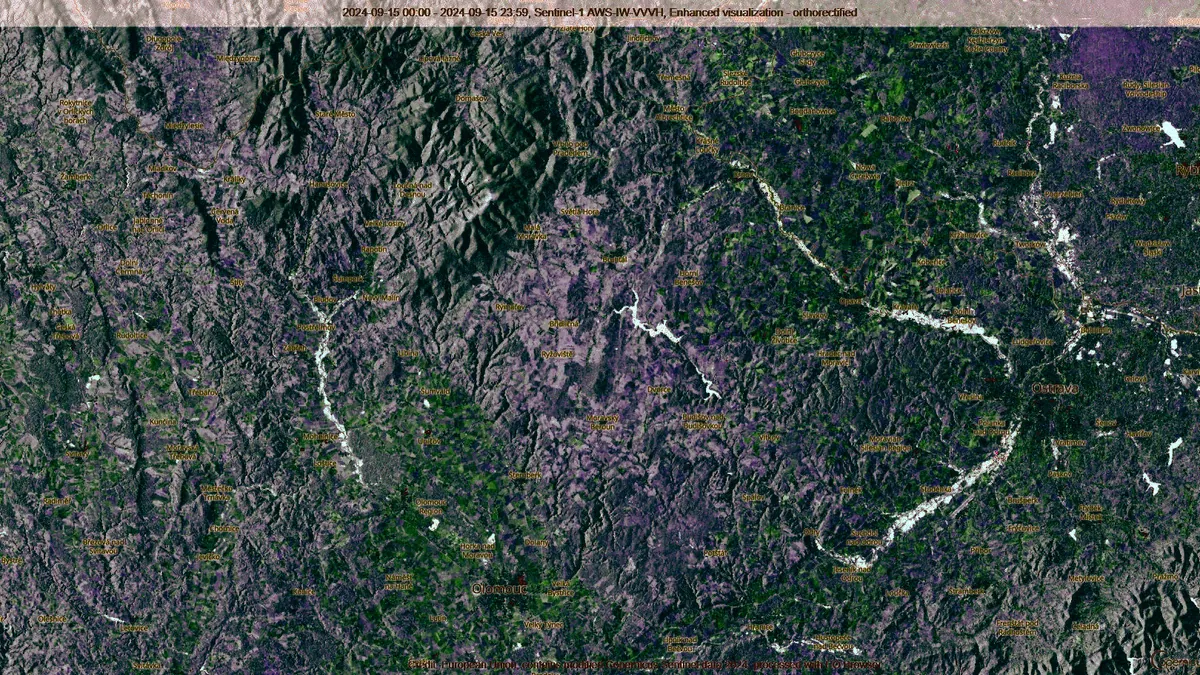
Archive image · Photo: Contains modified Copernicus Sentinel data 2024 processed by Sentinel Hub / Wikimedia Commons, CC BY 4.0 (cropped and resized)
Climate change intensified the floods caused by Storm Boris in September 2024 considerably more than it increased the rainfall itself. That is the finding of a team led by Peter Miersch of the Helmholtz Centre for Environmental Research (UFZ) in Leipzig, published on Wednesday in the journal Science Advances. Boris caused severe flooding mainly in Poland, Czechia and Austria, with several hundred millimetres of rain falling within a few days in some areas.
The researchers simulated the event in today's landscape both with and without human-caused warming. Without climate change, rainfall would have been about 6 to 9 percent lower depending on the climate model, while river flood peaks would have been on average about 14 to 22 percent lower. They combined two climate models with two hydrological models, one of them based on machine learning, and every combination showed the same effect. The ranges reflect differences between models; the release gives no formal confidence intervals.
Miersch attributes the gap to saturated soils: at first the ground absorbs part of the rain, but eventually "every additional millimetre of rain flows directly into the river". Co-author Jakob Zscheischler (UFZ and TU Dresden) warned that 10 percent more extreme rainfall does not mean only 10 percent more flooding, so hazard assessments based on precipitation alone may underestimate the increase. The study explicitly did not examine whether climate change makes weather patterns like Boris more likely.