
"Zurich Blue": ancient Egyptian Blue becomes a glowing marker for brain imaging
Empa researchers have turned Egyptian Blue, a pigment more than 4,500 years old, into a nano-pigment that glows in the near infrared and is meant to enable high-resolution images of brain structures.
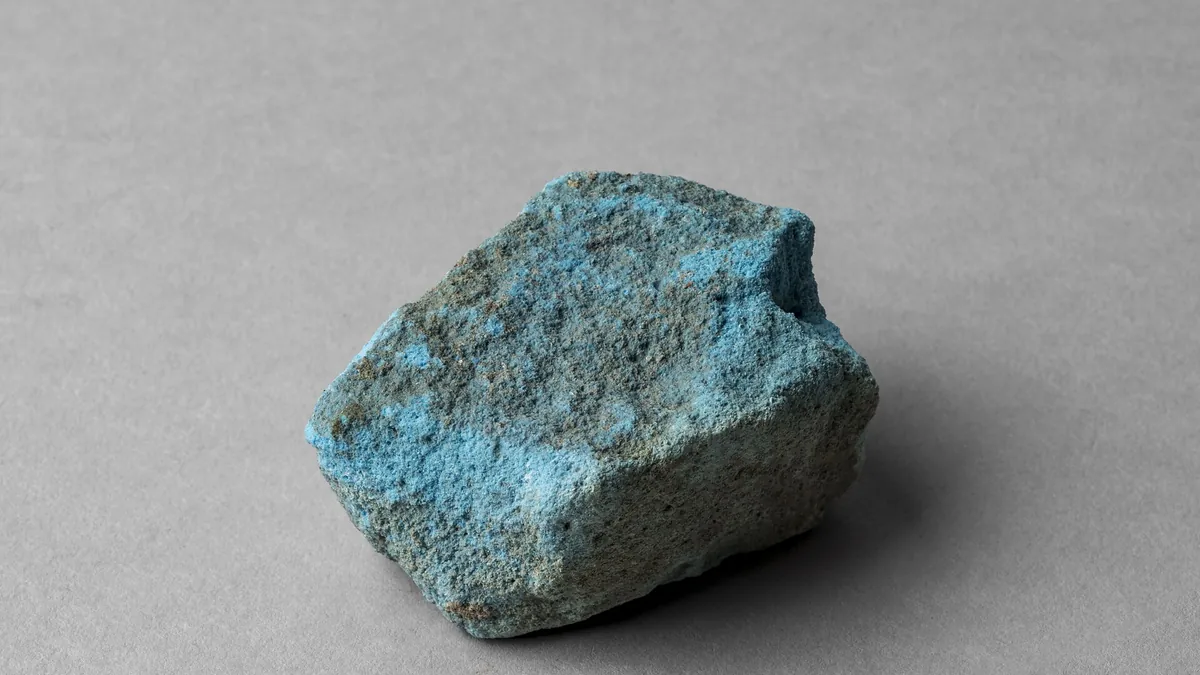
Symbolic image · Photo: Museo Egizio, Turin / Wikimedia Commons, CC0 (cropped and resized)
Egyptian Blue is considered one of the first artificially produced pigments; it was used more than 4,500 years ago in wall paintings, ceramics and statues. Under near-infrared light the pigment fluoresces – a property exploited by researchers at the Swiss Federal Laboratories for Materials Science and Technology (Empa). From the ancient model they created a nano-pigment called "Zurich Blue", which is meant to enable high-resolution images of brain structures, Empa announced on 29 October.
Materials scientist Robert Nissler of the Nanomaterials in Health lab in St. Gallen reversed the historical production process: flame synthesis first creates metal-oxide nanoparticles, which laser irradiation then assembles into two-dimensional, ultra-bright nanolayers. "The process is not only gentle and controllable, it is also scalable to an industrial scale," Nissler says. The team described the method back in 2025 in the journal Advanced Materials (DOI 10.1002/adma.202503159).
ETH Zurich, the University of Zurich and Balgrist University Hospital are also involved. Lab experiments with imaging expert Daniel Razansky have been promising, according to Empa; the next step is clinical application. "The new hybrid material is suitable for real-time super-high-resolution imaging," says team leader Inge Herrmann. Possible uses include tracking individual immune cells that have taken up the pigment in tissue, or coupling therapeutic agents to the pigment.