
Heatwave and wildfire smoke on the same day: 287 million more people exposed
A Monash University study in Science Advances finds the double burden hit ever more people in 2000–2019. Right now, smoke is choking the Amazon city of Manaus.
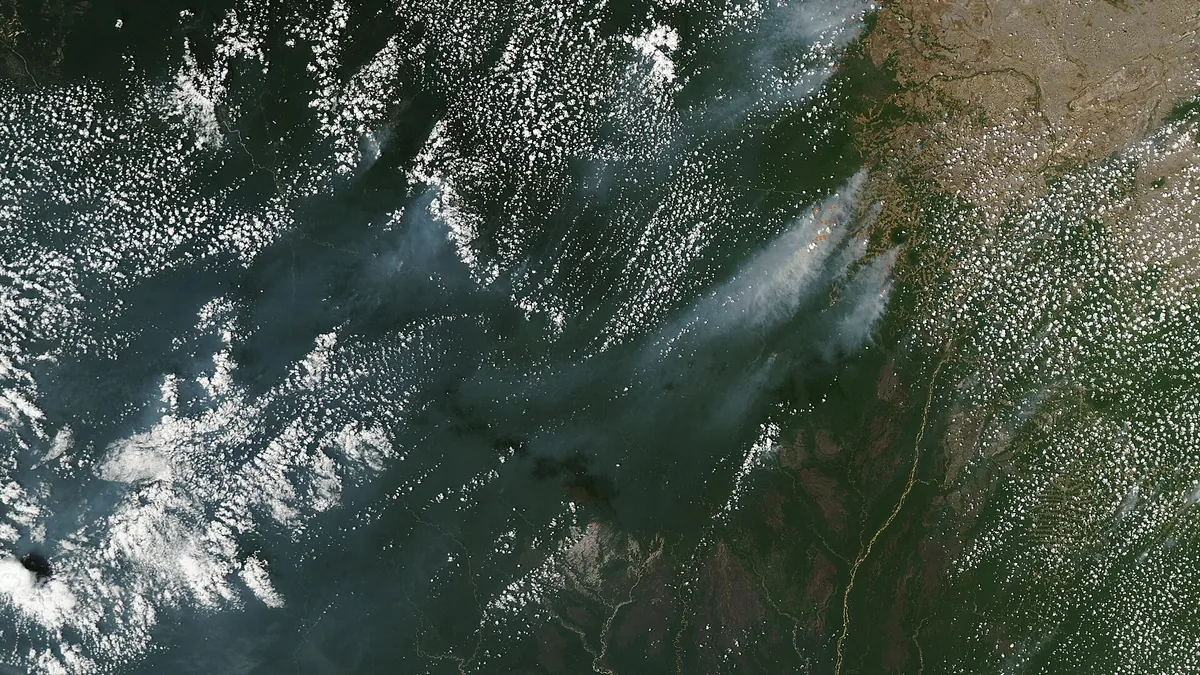
Archive image · Photo: MODIS Land Rapid Response Team, NASA GSFC / Wikimedia Commons, Public domain (cropped and resized)
A Monash University team including Yao Wu, Yuming Guo and Shanshan Li examined how often people worldwide face a heatwave and air pollution from landscape fires on the same day. The study was published on 14 October 2026 in Science Advances. It finds the number of people exposed rose by 287 million between 2000 and 2019; on average, 916 million people a year experienced at least one such day.
Average exposure rose from one day per person per year (2000–2009) to 1.7 days (2010–2019). Exposure increased for 52.4 per cent of people in populated areas. The most affected countries were DR Congo, Indonesia, Mexico, Brazil and Russia. The results are based on modelling; the authors expect more such combined events as warming continues, but the release describes no formal attribution analysis.
The Amazon currently shows what this looks like: according to NASA Earth Observatory, smoke engulfed Manaus on 12 October, fine particulate matter (PM2.5) exceeded 135 micrograms per cubic metre and schools closed. NASA scientist Douglas Morton links the fires to El Niño-related drought; nearly all were started by people, with lightning causing less than 1 per cent. A preliminary satellite analysis finds about 40 per cent more fires around Santarém than standard active-fire counts.