
Second jet reveals black hole pair – collision possible within 100 years
Bonn radio astronomers find a second jet at the centre of galaxy Mrk 501. It points to a second supermassive black hole – the two could merge in as little as a century.
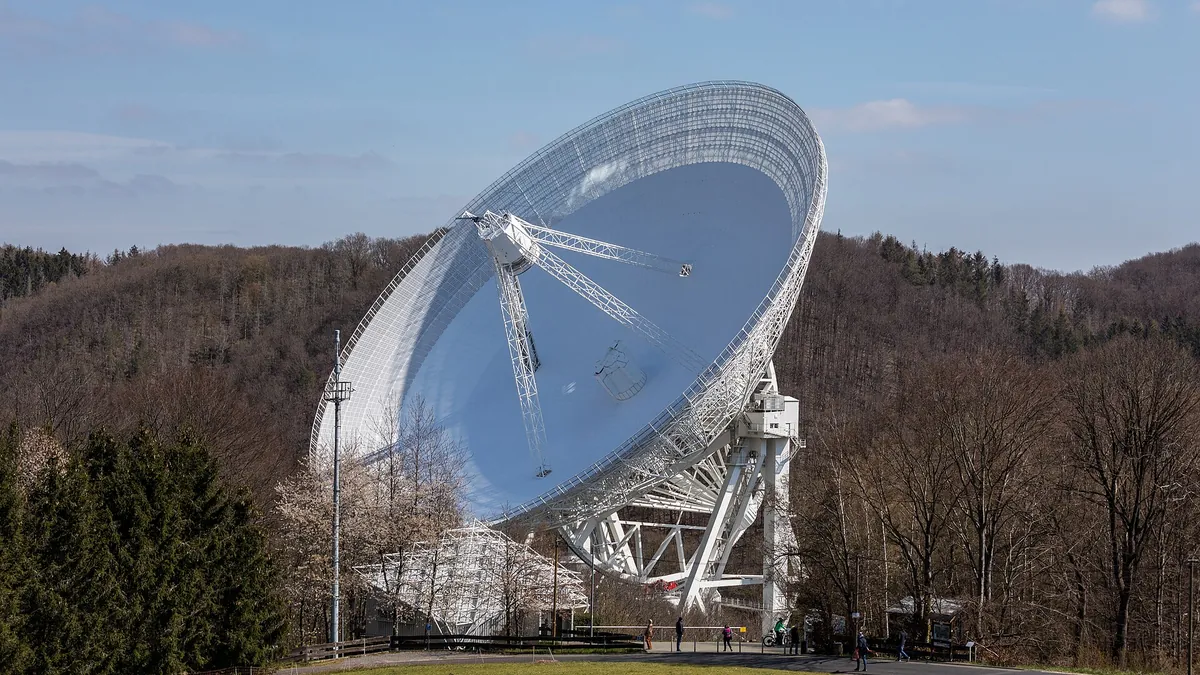
Symbolic image · Photo: Raimond Spekking / Wikimedia Commons, CC BY-SA 4.0 (cropped and resized)
A team at the Max Planck Institute for Radio Astronomy in Bonn has found a second, previously unseen jet in the core of galaxy Mrk 501. According to the researchers it is the first direct imaging evidence of such a system at a galaxy's centre and strongly suggests a second supermassive black hole. The two are too close together to be resolved individually. The study appears in the Monthly Notices of the Royal Astronomical Society.
The team examined multi-frequency radio observations taken on dozens of days over about 23 years. The pair appears to complete an orbit roughly every 121 days, separated by 250 to 540 times the Earth–Sun distance. Their masses are estimated at 100 million to 1 billion solar masses; depending on the actual masses, the black holes could merge in as little as 100 years.
"Evaluating the data felt like being on a ship. The entire jet system is in motion," says lead author Silke Britzen. The pair should emit extremely low-frequency gravitational waves detectable by pulsar timing arrays. Co-author Héctor Olivares says one might then even see their frequency steadily rise as the two giants spiral toward collision.