
Particle frozen in place: Oxford quantum computer recreates famous 1959 effect
Using trapped ions, physicists simulated the Aharonov-Bohm effect, in which a magnetic field affects a particle that never touches it. The method could ease simulations in particle physics.
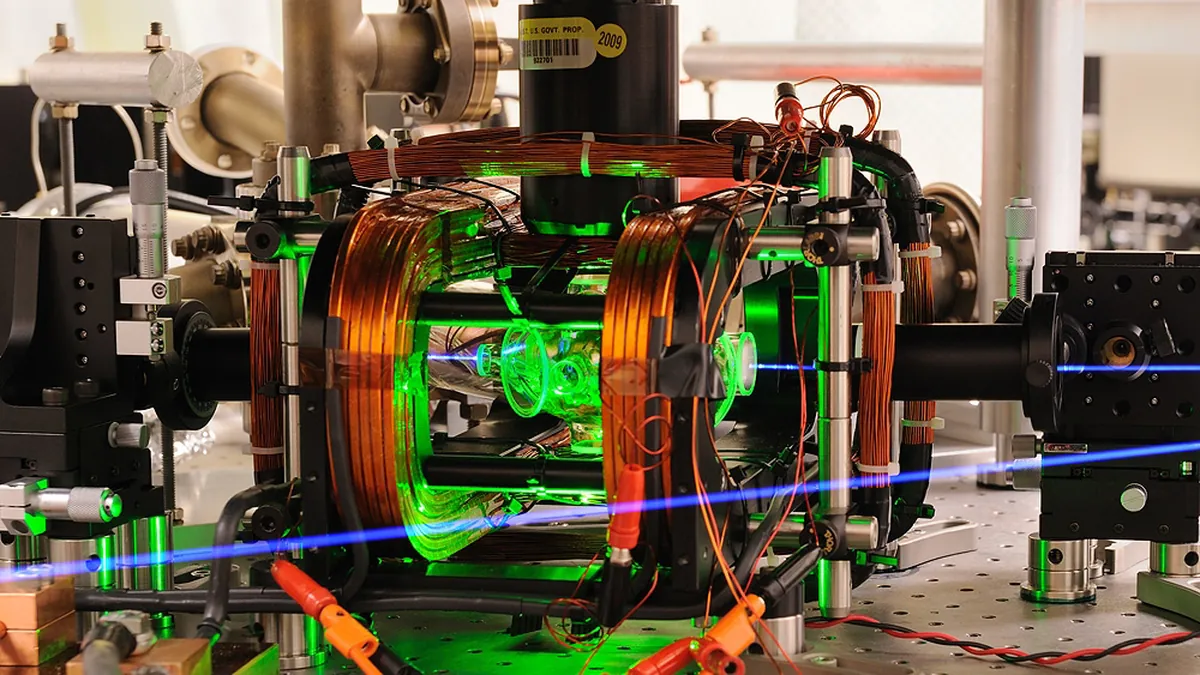
Symbolic image · Photo: National Institute of Standards and Technology / Wikimedia Commons, Public domain (cropped and resized)
Researchers at the University of Oxford have used a hybrid quantum computer to recreate an effect predicted by physicists Aharonov and Bohm in 1959: a charged particle is affected by magnetic flux even though it never passes through the field itself. The work was published in the journal Nature Physics. A theorist from Madrid also took part.
Trapped ions served as the building blocks. Their internal states acted as qubits representing the fields, while their vibrations represented matter. The basic unit was a small loop of two vibrational modes and two qubits. When the researchers simulated a magnetic flux, the particle's two possible paths cancelled each other out. The particle could no longer tunnel and stayed in place. The exciting step was encoding the flux in a field that was itself dynamical, lead author Sebastian Saner said.
The experiment has a practical aim: lattice gauge theories, which particle physicists use to describe interactions between matter and forces. Classical computers struggle as such systems grow. A University of Maryland team used a similar approach, published in the same journal, to simulate the so-called Yukawa potential.