
Small capacitor, big energy: Tsinghua team improves lead-free ceramic components
Multilayer ceramic capacitors sit in almost every electronic device. Researchers in Beijing reach 19.8 joules per cubic centimetre at 89.3% efficiency with a lead-free material.
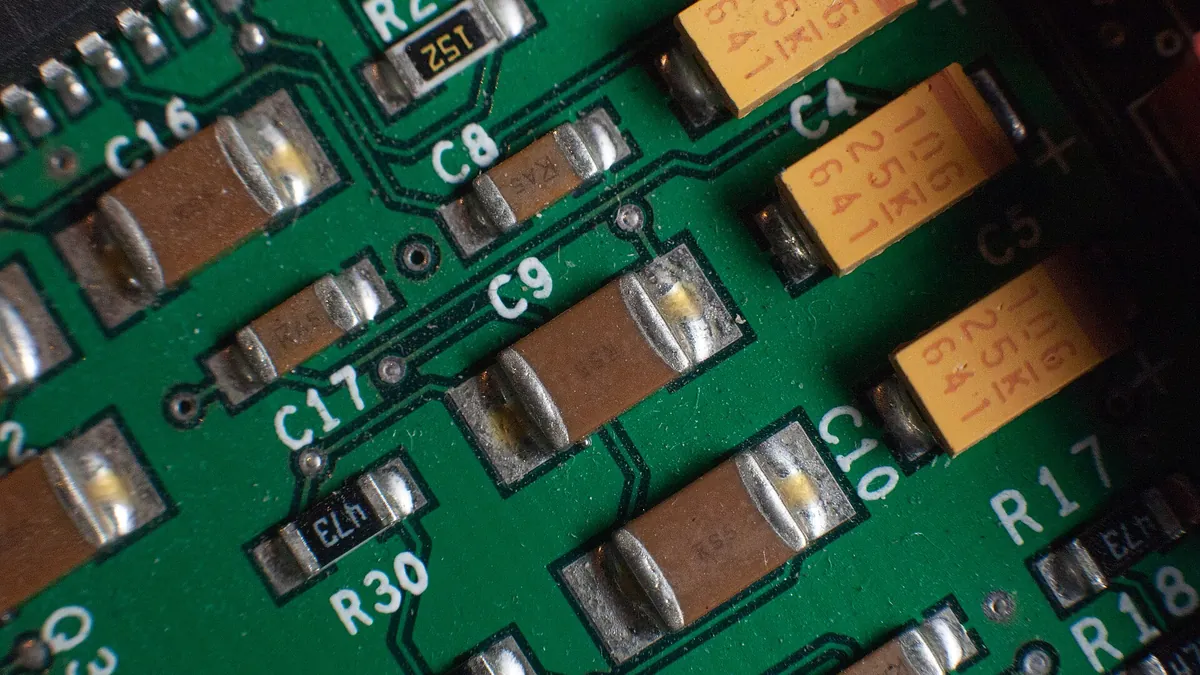
Symbolic image · Photo: Giovanna 27 / Wikimedia Commons, CC BY 4.0 (cropped and resized)
Multilayer ceramic capacitors (MLCCs) are among the most common components in electronic devices. Lead-free versions, however, hit their limits at high temperatures and strong electric fields: leakage currents rise and breakdown strength is limited. Researchers at Tsinghua University and Beijing University of Posts and Telecommunications published an approach to the problem in Nature Communications on Oct. 25.
Their material is based on barium titanate and is optimised on several levels at once: multiple elements are built into the crystal lattice, which the researchers describe as “high entropy”. The grains are refined and given a thin silicon dioxide shell, and an extra barrier layer separates the electrodes from the ceramic.
The result is an energy density of 19.8 joules per cubic centimetre at 89.3% efficiency and a field strength of 1,421 kilovolts per centimetre. The authors also report outstanding energy storage performance at high temperatures and see the approach as a general route to more capable capacitors for energy storage.