
Model study: Atlantic overturning circulation can recover – Greenland's ice cannot
In a Danish-Swedish climate model, the AMOC weakens sharply but recovers once warming is reversed – though only after centuries. An outside researcher is sceptical.
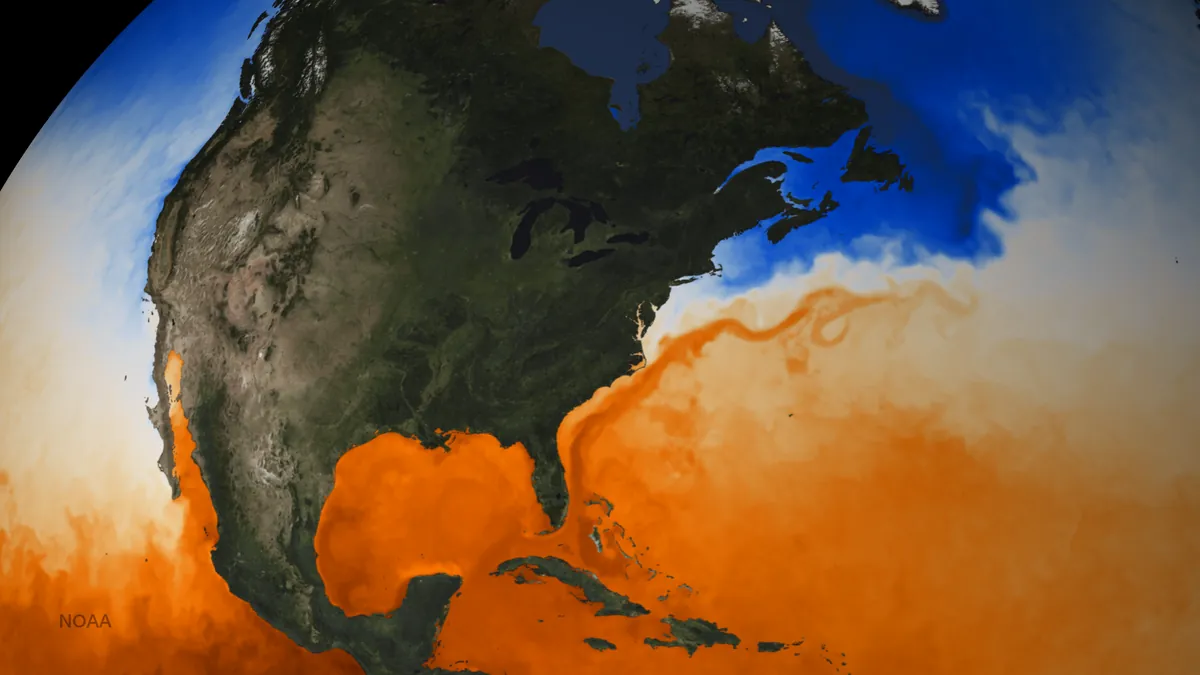
Symbolic image · Photo: NOAA / Wikimedia Commons, Public domain (cropped and resized)
The Atlantic Meridional Overturning Circulation (AMOC), a major current system in the Atlantic Ocean, weakens markedly under strong warming in a new computer model but does not tip irreversibly. That is the finding of researchers from the Danish Meteorological Institute (DMI) and the Swedish Meteorological and Hydrological Institute (SMHI), led by first author Chuncheng Guo, in the journal Science Advances (Oct. 14, 2026).
The team used the EC-Earth3-ESM-1 Earth system model, which couples the atmosphere, ocean, sea ice and the Greenland ice sheet. In a stress test, it raised global temperature by 7 degrees – far beyond current projections – and then reversed the warming in the model. The current fell from about 17 million to about 6 million cubic metres per second, a drop of nearly two-thirds. In no scenario did the AMOC reach a point of no return: it weakened gradually and began to recover as soon as temperatures fell, though the process could take several centuries. Greenland's ice, by contrast, did not come back; even after 1.5 degrees of warming, the study projects about 20 centimetres of long-term sea-level rise from Greenland melt.
The results are projections from a single model; the authors say comparisons with other models are still needed. The cooling required to reverse the weakening also exceeds what current technology can achieve. Willem Huiskamp of the Potsdam Institute for Climate Impact Research (PIK), who was not involved, said a more stable AMOC would be welcome news but doubted that the real-world current is as stable as some models suggest. In a PIK modelling study in Communications Earth & Environment (March 2026), the AMOC did not recover after a shutdown triggered by freshwater input at CO2 concentrations of 350 ppm and above. "It's a much, much safer strategy to not have warming in the first place," Guo said.