
Study: 3 percent of glaciers account for more than half of glacier ice loss
Glaciers ending in lakes, the ocean or ice shelves lost about 134 billion tonnes of ice a year in 2000–2019. Lake-terminating glaciers are shrinking especially fast, the study finds.
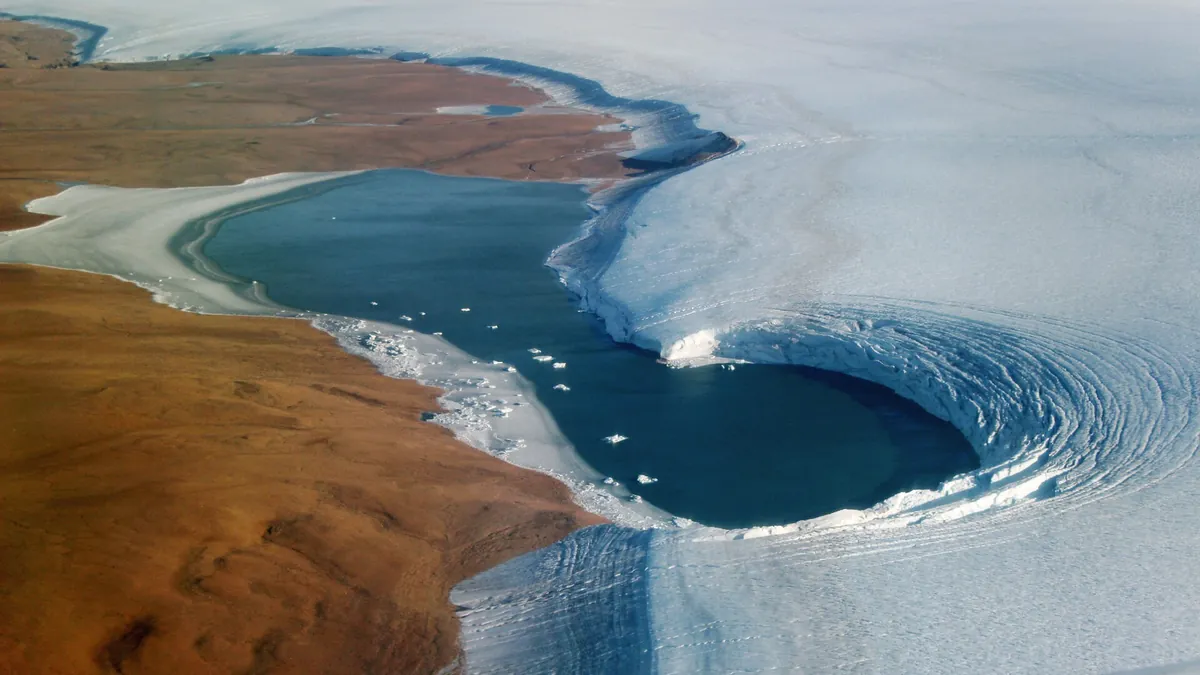
Symbolic image · Photo: NASA photograph by John Sonntag/Operation IceBridge / Wikimedia Commons, Public domain (cropped and resized)
Only about 3.2 percent of the world's glaciers end in a lake, the ocean or an ice shelf. Yet they account for more than half of all glacier ice loss, excluding the large ice sheets of Greenland and Antarctica. That is the finding of a team from the universities of Birmingham and Leeds, published in the journal Nature Communications on Oct. 23, 2026. These glaciers lost an average of about 134 billion tonnes of ice per year between 2000 and 2019, the study says. At the same time, they cover more than half of the world's glacier area. The researchers analysed data on 216,502 glaciers.
The researchers classified each glacier by where it ends – on land, in a lake, in the ocean or at an ice shelf – adding lake-terminating glaciers to existing inventories. They then compared flow speeds and mass loss while controlling for climate, size and elevation. Relative to their size, lake-terminating glaciers lose about 57 percent more ice than land-terminating ones and flow about 10 percent faster; ocean-terminating glaciers flow about 44 percent faster. "Glaciers ending in lakes really stand out: they're losing ice particularly quickly," said Joe Mallalieu, who carried out the work at Birmingham and is now at Leeds.
The study looks back at existing data for 2000 to 2019; it is not a projection. The university's release gives no uncertainty ranges for the headline figures. Why lake-terminating glaciers are shrinking so fast is still unclear, Mallalieu said – it could be the lakes themselves, the size and shape of the glaciers, or both. "Bringing these datasets together lets us compare how glaciers in different settings are behaving," said Nicholas Barrand of the University of Birmingham.