
Hurricane Polo: climate change had at least as much effect as El Niño
Rapid analysis by World Weather Attribution: warming made the conditions behind the record Pacific storm about 23 times more likely, El Niño about 14 times. The study has not yet been peer-reviewed.
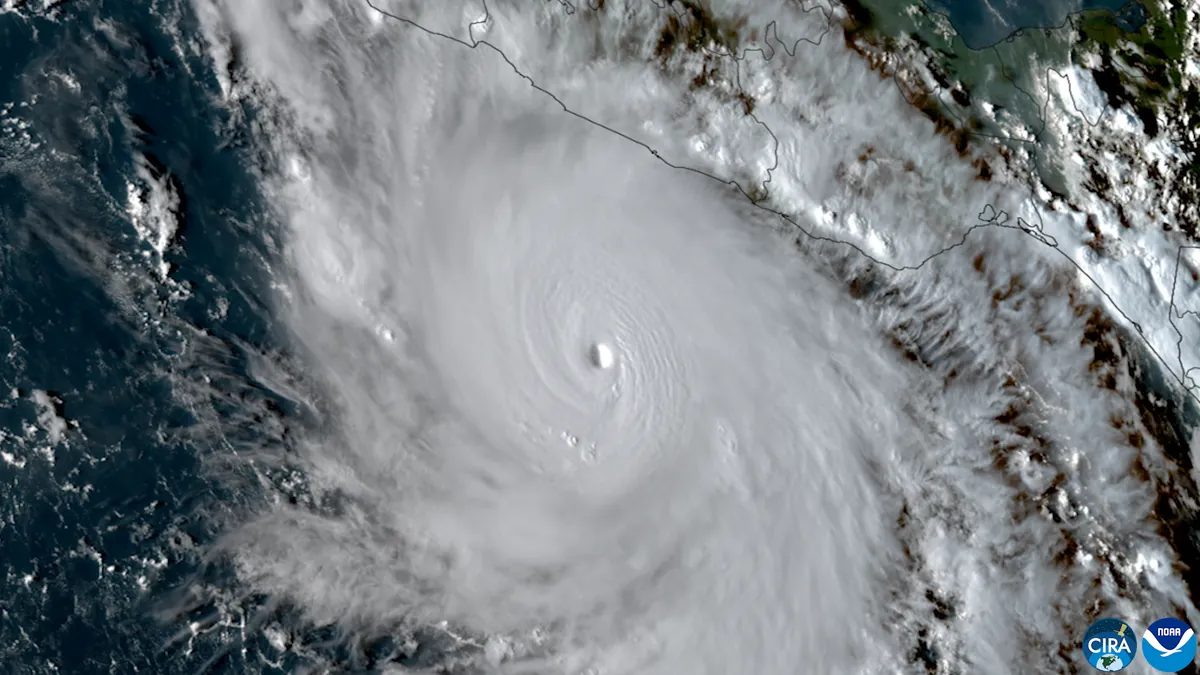
Photo: GOES imagery: CSU/CIRA & NOAA / Wikimedia Commons, Public domain (cropped and resized)
In September, Hurricane Polo became the longest-lasting Category 5 storm ever recorded in the Pacific: it held that strength for two and a half days and grew from a tropical storm to a Category 5 hurricane in about 24 hours. It hit Baja California Sur in weakened form on 28 September and the Mexican mainland near Guaymas on 29 September. According to World Weather Attribution (WWA), four people died in floods in Jalisco and one in Sonora. In the US state of New Mexico, around 1,000 people were evacuated over fears of a dam failure.
A rapid analysis by WWA published on 15 October, involving scientists from Mexico, the US, the UK, Ireland and the Netherlands, concludes that human-caused climate change made the conditions for the maximum possible storm strength (potential intensity) about 23 times more likely and raised it by about 5 metres per second. The strong El Niño made them about 14 times more likely, adding around 4.2 metres per second. Without human influence, such conditions would statistically be a roughly once-in-115-years event. The sea along the storm's track was about 1.4 degrees warmer than pre-industrial, and such temperatures have become about 200 times more likely, according to WWA. Climate Central, which took part in the study, reached a similar conclusion using a slightly different method: climate change added almost 10 km/h to Polo's wind speed, El Niño about 8 km/h.
"El Niño comes and goes, but climate change only gets worse," WWA lead Friederike Otto told the Associated Press. The study has not been peer-reviewed. The researchers could not quantify the influence of climate change on the extreme rainfall, because climate models fail to reproduce the observed trends in the region; measurements do show, however, that such downpours have become about six times as likely. Co-author Daniel Gilford of Climate Central acknowledges the estimate may be conservative. Several independent scientists, including Michael Mann (University of Pennsylvania), consider the climate effect more likely underestimated.