
Pace of warming more than doubled – cleaner air a possible driver
University of Kansas study: since 2011, global temperature has risen by about 0.4 degrees per decade. One suspected cause is the decline in cooling air pollution, especially over East Asia.
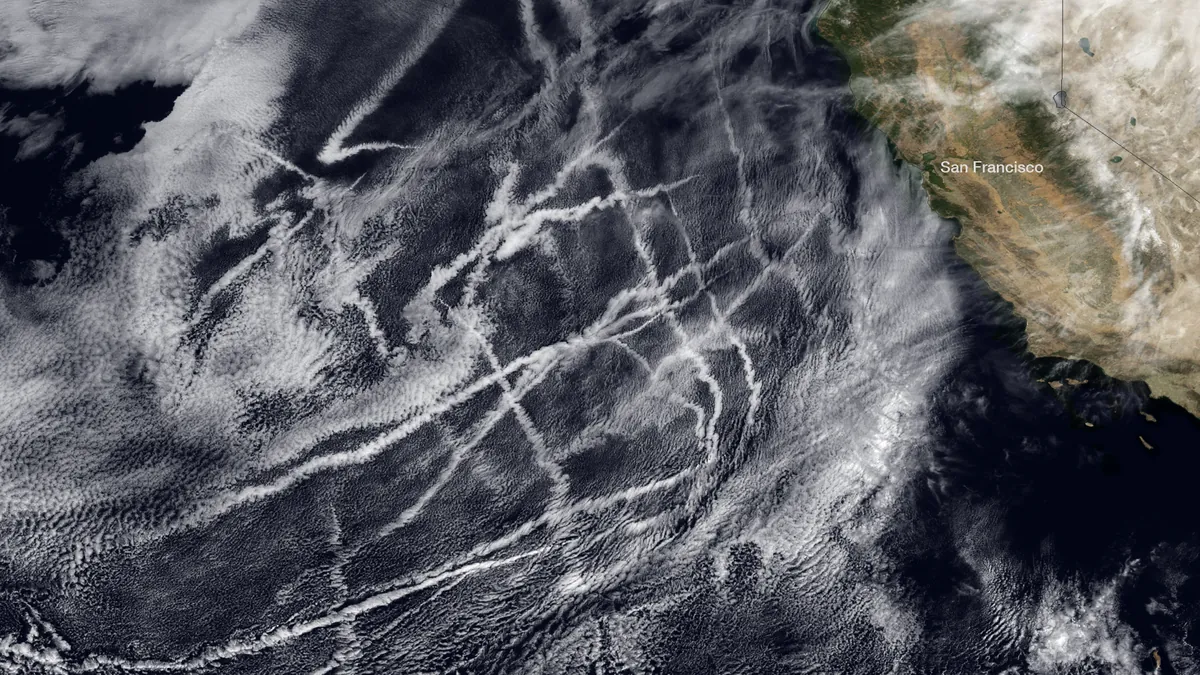
Symbolic image · Photo: NOAA / Wikimedia Commons, Public domain (cropped and resized)
Global warming has accelerated markedly over the past 15 years. That is the finding of a team led by climate scientist Qinjian Jin of the University of Kansas, published in the journal "npj Climate and Atmospheric Science". Analysing five global temperature datasets, they found that temperatures rose by about 0.40 degrees per decade from 2011 to 2025 (95 per cent range: 0.25 to 0.49 degrees), compared with 0.18 degrees between 1971 and 2010. The increase is statistically significant in all five datasets. These are measured data, but over a short period: the result depends heavily on the very warm years 2024 and 2025.
The researchers name the decline in cooling air pollution as a possible driver. Fewer airborne particles (aerosols), especially over East Asia and along shipping routes, block less sunlight. Three regions contribute most to the acceleration: East Asia with the adjacent North Pacific, the Eurasian mid-latitudes, and the South Atlantic and Antarctic region. Without their trends, the global rate falls arithmetically from about 0.39 to 0.26 degrees per decade. Why Eurasia and the South Atlantic are warming so strongly remains unclear; the aerosol link is an explanation, not proof.
The average of 26 climate models, at 0.29 degrees per decade, is below the observed value, although eleven individual models do show a clear acceleration. The researchers suspect that some models do not fully capture how declining aerosols affect clouds. If the recent pace continues, the 1.5-degree mark would be reached as a 20-year average around 2028 (range 2026 to 2031); with the long-term trend since 1971, not until 2037. This is a conditional extrapolation, not a model projection, and whether the high pace will continue is open. According to scientific consensus, greenhouse gases remain the main cause of warming.