
Thwaites Glacier: new model projects up to twice as much sea-level rise
A study involving NASA's Jet Propulsion Laboratory accounts for seawater intruding beneath the ice. Result: up to three centimetres of rise by 2100, roughly double previous estimates.
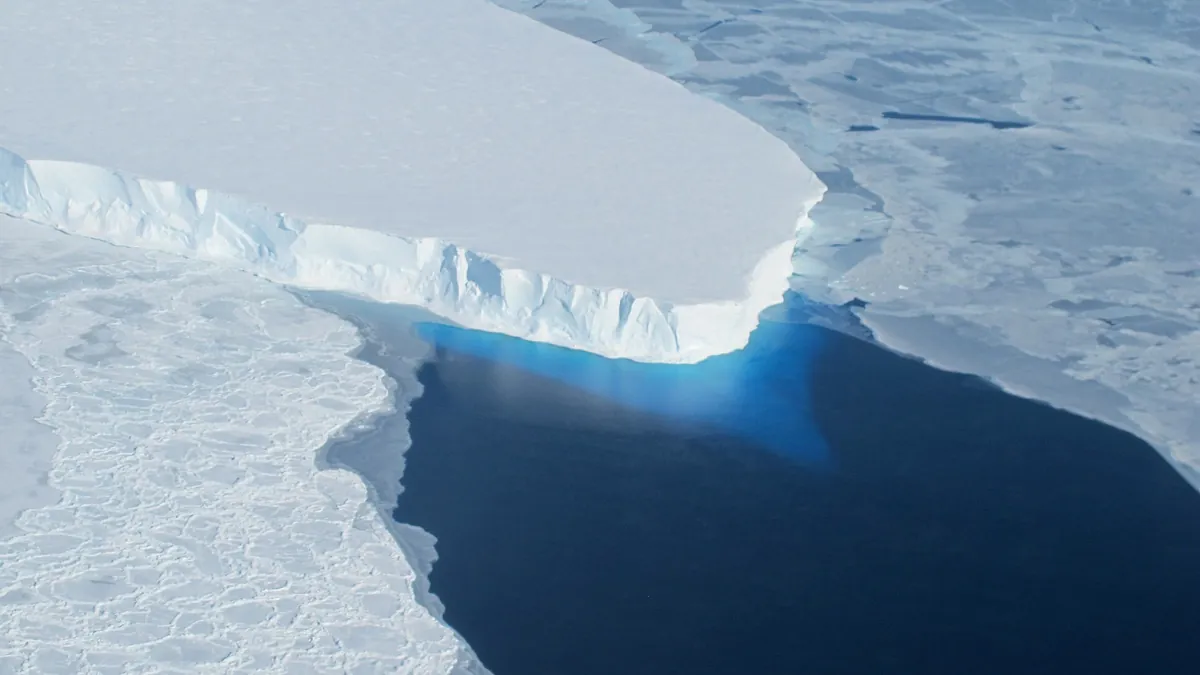
Archive image · Photo: NASA / Wikimedia Commons, Public domain (cropped and resized)
Thwaites Glacier in West Antarctica could contribute more to sea-level rise by 2100 than previously thought. That is the finding of a team led by Mattia Poinelli that includes researchers from NASA's Jet Propulsion Laboratory (JPL) and glaciologist Eric Rignot, published Oct. 12 in the journal Nature Communications. The researchers built kilometre-wide zones into an ice-sheet model in which seawater intrudes beneath ice still resting on bedrock and melts it from below. Previous models mostly treat the so-called grounding line as a sharp boundary. A 2024 study led by Rignot in PNAS had already described such intrusions beneath Thwaites.
The model was tested against nearly three decades of observations, including satellite measurements of flow speed, thinning and the position of the grounding line. It reproduced the observed retreat only with melt zones 2 to 5 kilometres wide. In the 5-kilometre version, the projection yields a contribution of 30.1 ± 5.7 millimetres to global sea level by 2100, about double the mean of the international ISMIP6 model comparison (15.2 ± 21.8 millimetres). Without such zones, the figure is 8.3 ± 3.0 millimetres. The authors put the probability that the glacier detaches by 2100 from Mouginot Ridge, a pinning point on the seafloor, at about 45 percent for zones 2 to 3 kilometres wide and about 60 percent for 4 to 6 kilometres; with 5 to 6 kilometres, as early as 2038.
Context: These are model projections. They assume constant, deliberately low climate forcing (the 1996–2023 average) with no further warming, and they exclude calving at the glacier front. A test with ocean water 0.5 to 0.7 degrees Celsius warmer increased ice loss by about 15 percent. According to the study, all of Thwaites' ice is equivalent to 65 centimetres of sea level; the millimetres projected by 2100 are only a small part of that. The authors call for more ocean measurements directly at the grounding line.
Sources
- Nature Communications – Poinelli et al.: Sea-level contribution from Thwaites Glacier doubles in an observation-constrained ice-sheet model (12.10.2026)
- PNAS – Rignot et al.: Meerwasser-Intrusion unter dem Thwaites-Gletscher (Referenzstudie, 2024)
- Earth's Future – Seroussi et al.: Evolution of the Antarctic ice sheet over the next three centuries (ISMIP6, 2024)