
Quantum computing: researchers link entangled photons on demand
A Tsinghua University team fuses small groups of entangled microwave photons into larger structures in a programmable way, a possible building block for photonic quantum computers.
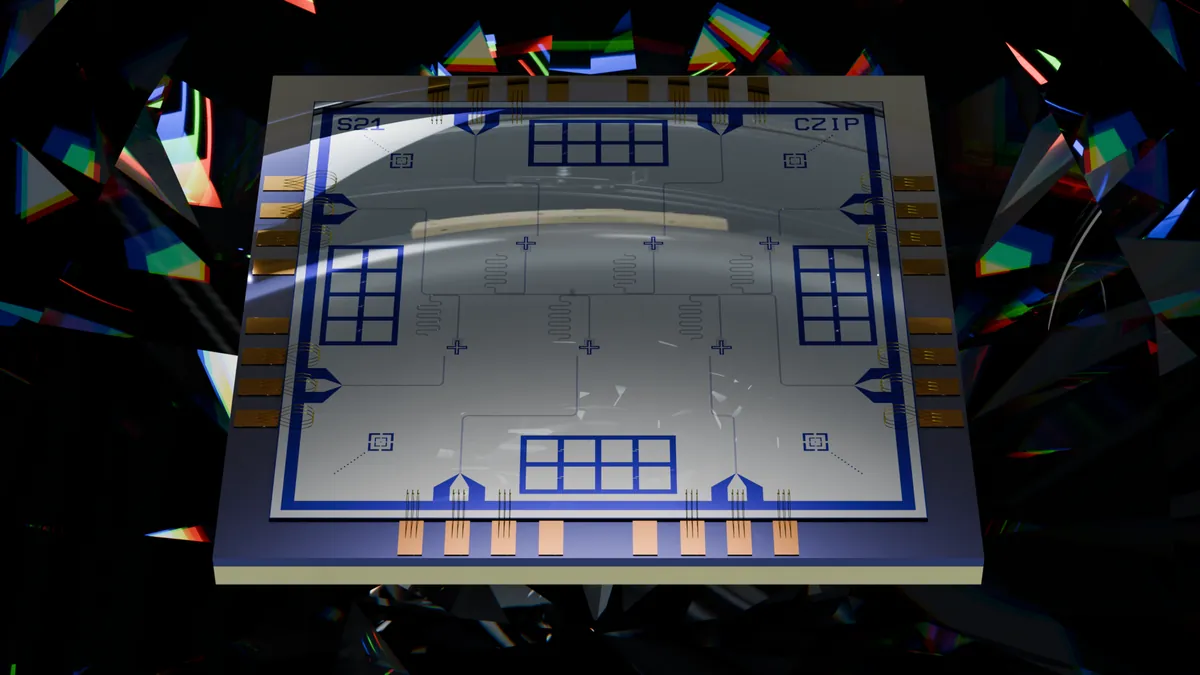
Symbolic image · Photo: OJB Quantum / Wikimedia Commons, CC BY 4.0 (cropped and resized)
Researchers at China's Tsinghua University have shown how small groups of entangled photons can be deliberately joined into larger quantum states. The team led by Hongyi Zhang used a superconducting quantum circuit and microwave photons, German science magazine scinexx reported. The results were published in Nature Physics.
A special quantum detector measures the joint parity of selected photon pairs without destroying them, entangling them and thereby linking two groups. Both possible measurement outcomes can be used, which is why the method is described as deterministic. By tuning the frequency of individual photons, the researchers choose which pairs are linked, making the pattern programmable.
In the largest experiment, three clusters of 4, 5 and 4 qubits were combined into a linear structure with 11 nodes, encoded in 13 photonic qubits; a ring-shaped structure with five nodes was also demonstrated. The setup is still a laboratory experiment with microwave photons and cannot yet be used over optical fiber. State quality and detector performance still need to improve.