
Study: drying soils amplify fire weather in eastern Siberia
About 60% of the trend towards drier summer air in eastern Siberia is down to atmospheric circulation, a Chinese study finds, and soil feedback amplifies it. Sea-ice loss in the Laptev Sea plays a role.
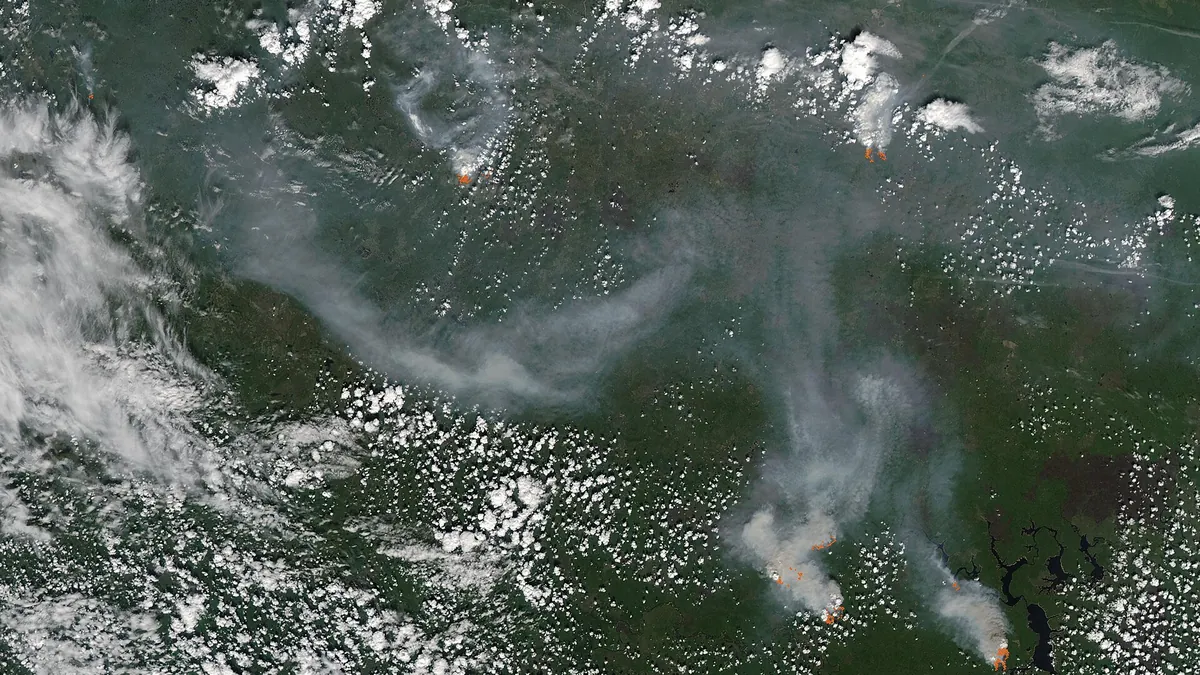
Archive image · Photo: MODIS Land Rapid Response Team, NASA GSFC / Wikimedia Commons, Public domain (cropped and resized)
Wildfires in eastern Siberia have intensified. A team led by Dongping Bai and Haipeng Yu of the Chinese Academy of Sciences' Northwest Institute of Eco-Environment and Resources in Lanzhou published an analysis of the causes on 10 October 2026 in Communications Earth & Environment. The researchers examined vapour pressure deficit (VPD), a measure of how "thirsty" the air is and a key indicator of fire weather. The analysis covers the summers of 2004 to 2024 and relies on reanalysis data, meaning observations processed with a weather model.
According to the study, atmospheric circulation explains about 60% of the trend towards drier summer air. Land-atmosphere feedback in turn accounts for about 42% of that circulation contribution. The mechanism: less sea ice in the Laptev Sea favours a high-pressure system over eastern Siberia, which suppresses rainfall and dries the soil. Drier soil releases less moisture through evaporation and heats the air instead, raising dryness further. The abstract gives no uncertainty ranges for these shares.
A 2024 study in Nature Communications had already linked about 80% of the rise in air dryness in the region between 2004 and 2021 to rapid summer sea-ice loss in the Russian Arctic. The new work adds the amplifying role of the soil. Limitations: the period covers only 21 years, and the published text is an early version. The study is not an attribution analysis of any individual fire.