
Nature: Amazon releases more CO2 than it absorbs, driven mainly by fires
Fifteen years of research flights show the Amazon released about 1.17 billion tonnes of CO2 a year on average. Droughts amplify the effect, but the study blames human activity.
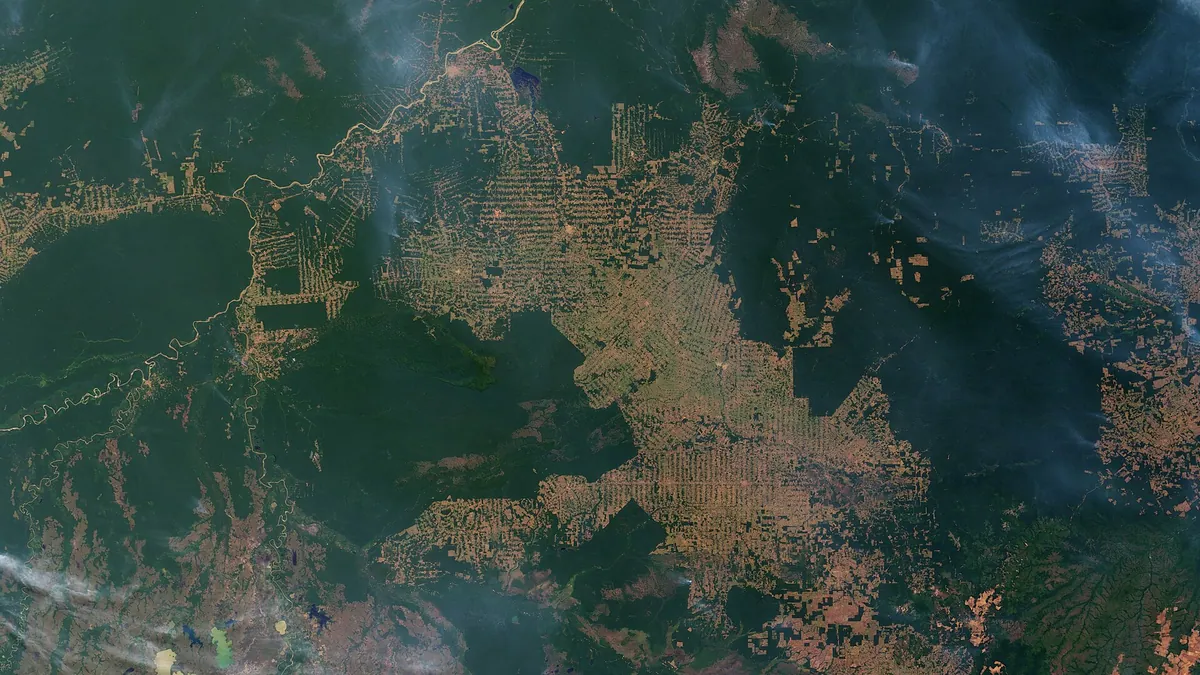
Symbolic image · Photo: Jesse Allen and Robert Simmon / Wikimedia Commons, Public domain (cropped and resized)
The Amazon rainforest was a net source of carbon dioxide between 2010 and 2024, according to a study published in Nature on Oct. 21. It was led by climate scientist Luciana Gatti of Brazil's National Institute for Space Research (INPE), with partners including the U.S. agency NOAA and the University of São Paulo. On average the region released about 0.32 billion tonnes of carbon a year, equivalent to roughly 1.17 billion tonnes of CO2. Fires alone accounted for about 1.47 billion tonnes, while vegetation took up only around 300 million tonnes net.
The figures are based on measurements. Small aircraft sampled air at four sites at altitudes of up to 4.4 kilometers, 1,017 vertical profiles in all, and compared it with air arriving from the Atlantic. In drought years such as 2015, 2016, 2023 and 2024 the balance reached about 1.8 billion tonnes of CO2. In 2019-2022 it rose to about 1.58 billion tonnes as deforestation increased by 97% although conditions were barely drier. Lightning started only 1.6% of fires in 2023. "The problem in the Amazon is human activity," Gatti said, according to FAPESP.
The reports give no formal error margins, and year-to-year swings are large. The authors consider fire emissions in 2023 and 2024 more likely underestimated, because some high-rising smoke lies above the sampling flights. Over 46 years rainfall in the region fell by about 8% and temperatures rose by 1.13 degrees Celsius. El Niño droughts amplify the effect but are not the underlying cause, the researchers said.