
Chance find in Draco: ESA telescope Euclid discovers its first comet
Euclid normally maps the dark universe. Now software has spotted a previously unknown comet in its images. It has been named C/2026 S1 (Euclid).
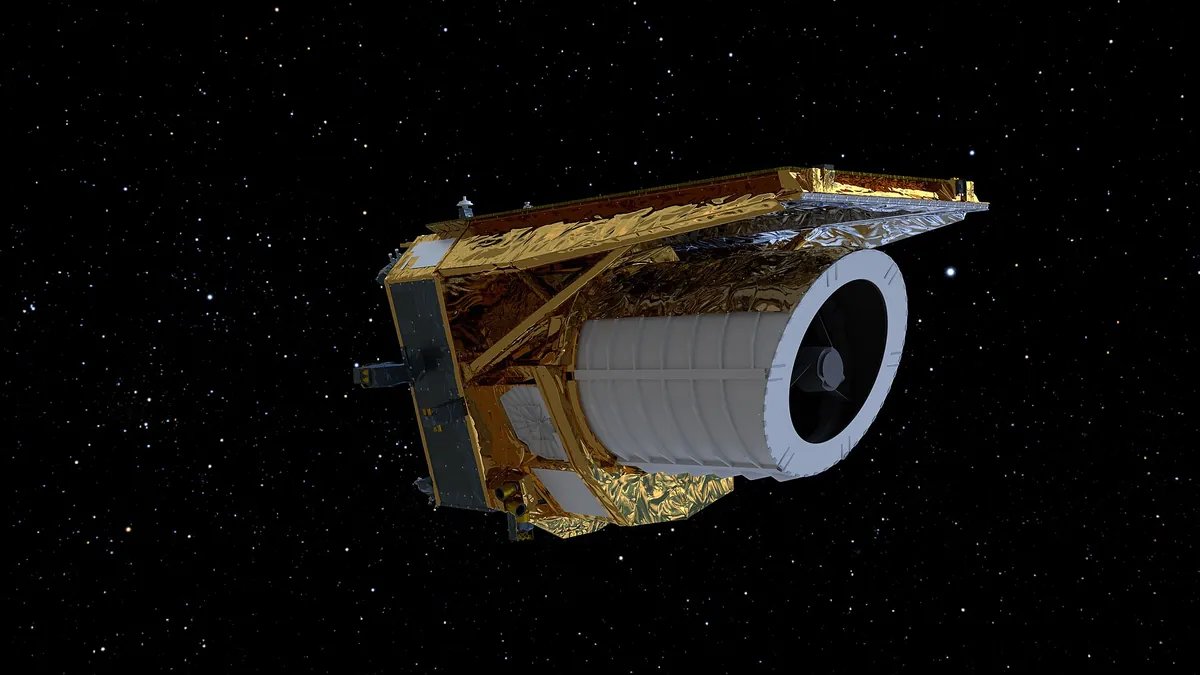
Photo: European Space Agency / Wikimedia Commons, CC BY-SA 3.0 igo (cropped and resized)
The European Space Agency's Euclid space telescope has discovered a comet for the first time. The object appeared in images Euclid took of its Deep Field North in the constellation Draco between 16 and 24 September 2026. The Minor Planet Center assigned it the designation C/2026 S1 (Euclid). Ground-based observations confirmed the discovery.
It was spotted by software written by Mikko Pöntinen of the University of Helsinki, which flagged a streak left by a fast-moving object and predicted its position in further images. A fuzzy envelope pointed to an active comet. 'I was excited to see my software flag a streak smeared across several images,' Pöntinen said. The comet is about 1.3 billion kilometres from Earth and takes thousands of years to complete one orbit.
Hunting comets is not among Euclid's tasks – the telescope is designed to study dark matter and dark energy. 'Very few comets are expected to be discovered by Euclid,' said ESA archive scientist Bruno Altieri. Project scientist Valeria Pettorino said the team was pleased to have found a previously unknown comet.