
Japan's MMX probe is on its way to Mars moon Phobos – samples due back in 2031
An H3 rocket launched the MMX probe. It is to reach Mars in 2027, land twice on Phobos and bring about ten grams of material to Earth. On board: a German-French rover.
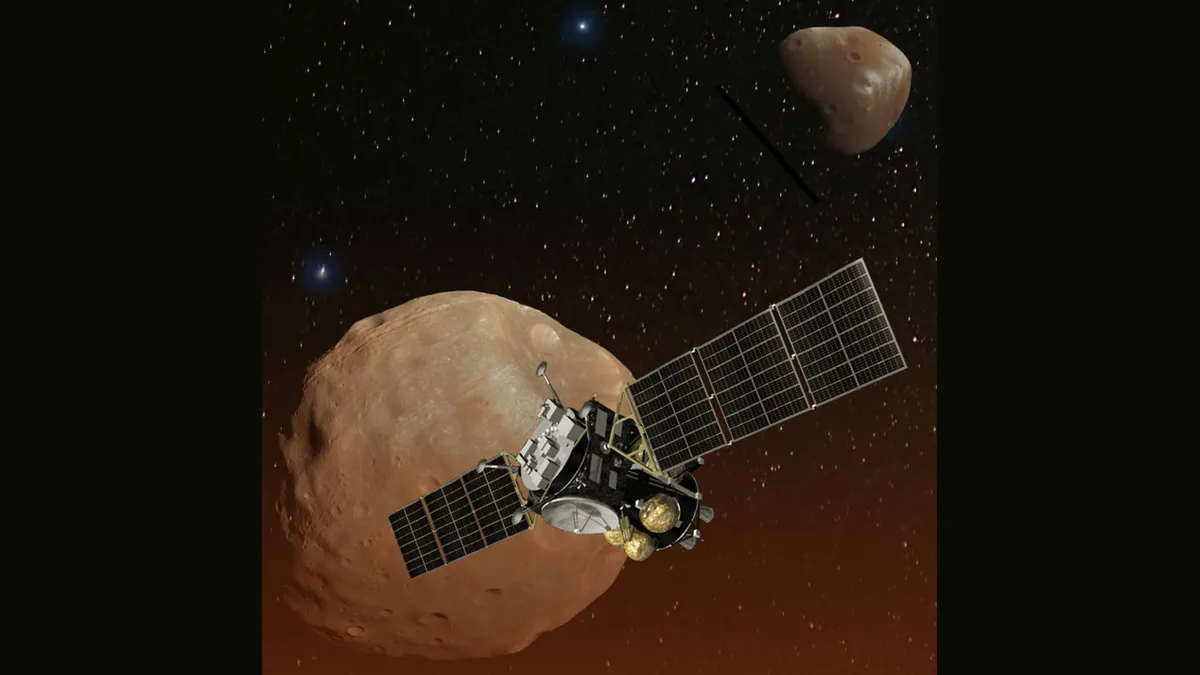
Photo: NASA / Wikimedia Commons, Public domain (cropped and resized)
Japan's space agency JAXA has launched its Martian Moons eXploration (MMX) mission. An H3 rocket lifted off from Tanegashima Space Center at 19:41 GMT on Monday (4:41 a.m. local time on Tuesday), the tenth launch of the rocket type. According to Space.com, the probe separated from the upper stage on schedule about 71 minutes after liftoff, after a final engine burn put it on course for Mars.
MMX is scheduled to reach Mars in August 2027 and spend about three years in the Martian system. Two landings on the moon Phobos are planned, collecting about ten grams of surface material. The probe is to leave for Earth in November 2030, with the sample capsule landing in Australia in 2031. Scientists hope to determine whether Phobos and Deimos are captured asteroids or formed in a giant impact.
The German Aerospace Center (DLR) and the French agency CNES are providing the roughly 25-kilogram rover Idefix, which is to be dropped onto Phobos from a height of about 40 metres and operate for around 100 days. NASA is supplying a spectrometer and a sampler, among other things, and is investing about 87 million dollars, according to Space.com. It is Japan's second Mars mission – the first, Nozomi, failed to enter orbit in 2003.