
Fusion: heat first, then compress – Princeton researchers see an energy-saving detour
Physicists at the Princeton Plasma Physics Laboratory have extended a 70-year-old rule of thumb in fusion research. Their finding: reaching ignition could take far less energy.
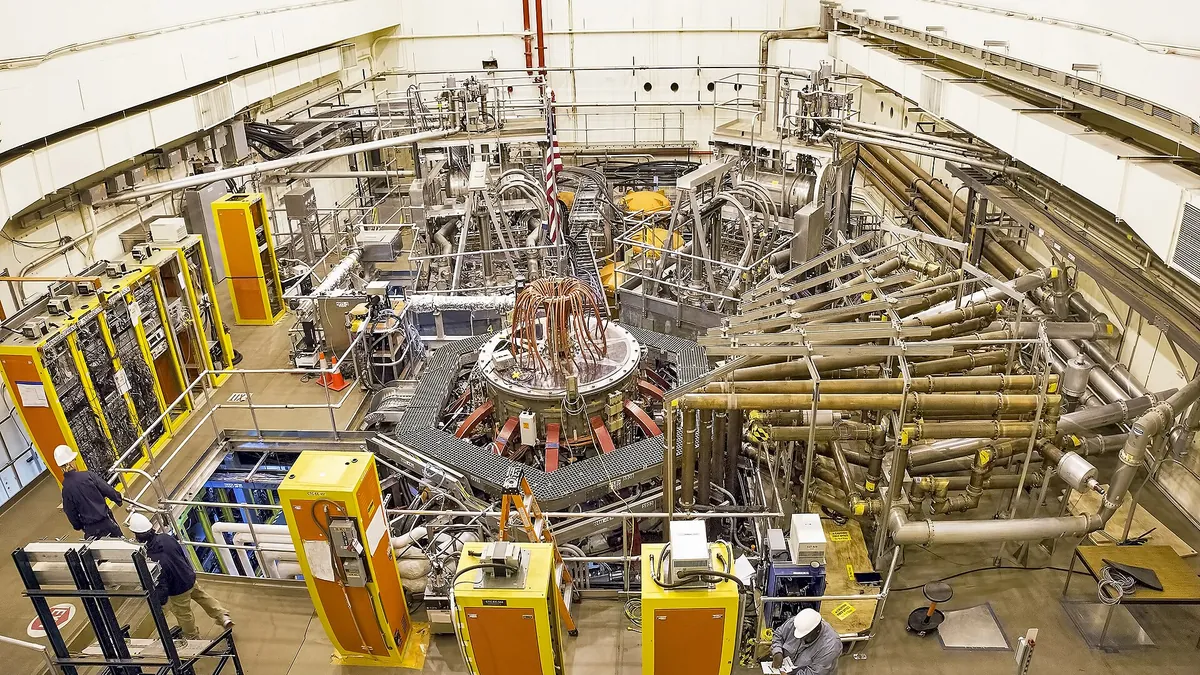
Archive image · Photo: PPPL Princeton Plasma Physics Laboratory from Princeton, NJ, U.S.A. / Wikimedia Commons, CC BY 2.0 (cropped and resized)
For more than seven decades, fusion researchers have used the so-called Lawson criterion to estimate when a plasma ignites and sustains itself. Luis Delgado-Aparicio, Masayuki Ono and Jonathan Menard of the US Department of Energy's Princeton Plasma Physics Laboratory have now extended the rule with four factors: helium ash build-up, plasma contamination, synchrotron radiation and heat loss. The work was published in the journal Physical Review Letters.
According to their calculations, it could take substantially less energy to heat the plasma strongly first and only then raise its density, rather than taking the usual density-first route. "Go around the peak instead. You reach the same place in a much smarter way, and you use far less energy," Delgado-Aparicio said. At the same time the researchers warn that just one part tungsten per 10,000 can roughly double the pressure needed for ignition. Tungsten has been chosen for the inner walls of more than a dozen next-generation fusion machines. The results are purely theoretical and have not been tested experimentally. The team names liquid lithium coatings among possible countermeasures. Computer simulations are planned next.