
Study: Greenland ice retreated far when summers were about 4.7 degrees warmer
Sediment from beneath Greenland's ice sheet shows Camp Century was ice-free about 416,000 years ago, when summers there were about 4.7 degrees warmer than today. The study appeared in Climate of the Past.
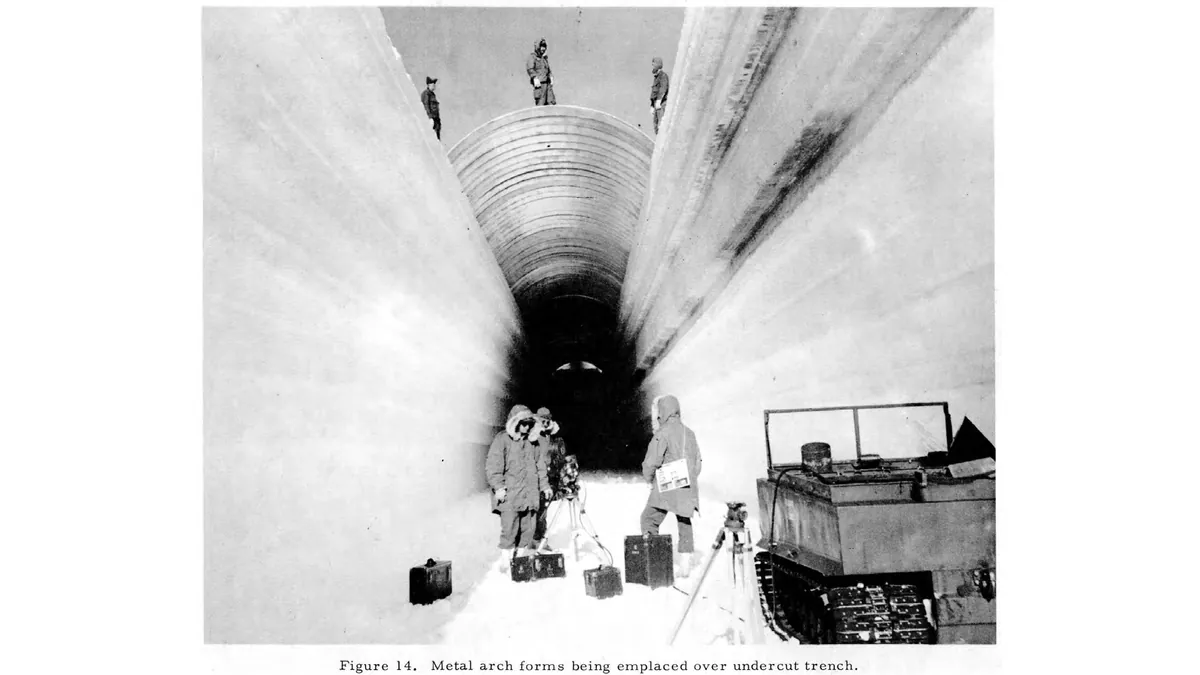
Archive image · Photo: U.S. Army Corps of Engineers, CRREL / Wikimedia Commons, Public domain (cropped and resized)
About 416,000 years ago, north-western Greenland at the site of the former US station Camp Century was free of ice, with summer temperatures about 4.7 degrees Celsius above today's. That is the finding of a team led by John Michael Aguilar and Elizabeth Thomas of the University at Buffalo, published in the journal Climate of the Past (online since 28 September, press release dated 20 October). For the site to become ice-free, the ice sheet there must have retreated more than 60 miles, or almost 100 kilometres, from its present edge.
The result is a reconstruction based on laboratory analyses, not model calculations: the team studied sediment recovered in the 1960s during the military Project Iceworm from almost a mile beneath the ice. The researchers measured fatty molecules produced by bacteria, whose composition changes with temperature, and compared them with samples from present-day Arctic lakes. The press release gives no uncertainty range for the 4.7-degree estimate. The work was funded by the US National Science Foundation.
The finding matters because the Arctic is warming rapidly: the Intergovernmental Panel on Climate Change (IPCC) projects that average annual Arctic temperatures could rise by 3.3 to 10 degrees by the end of the century, depending on emissions – a model projection, not a result of the study. Today's human-caused warming is more intense than the warm period 400,000 years ago, co-author Thomas said. The release does not say how quickly the ice sheet would respond today.