
Fusion research: Wendelstein 7-X in Greifswald starts a new round of experiments
The world's largest stellarator is running again: until 10 December and from February, experiments usually run three days a week. Of more than 600 proposals, around 250 were given priority.
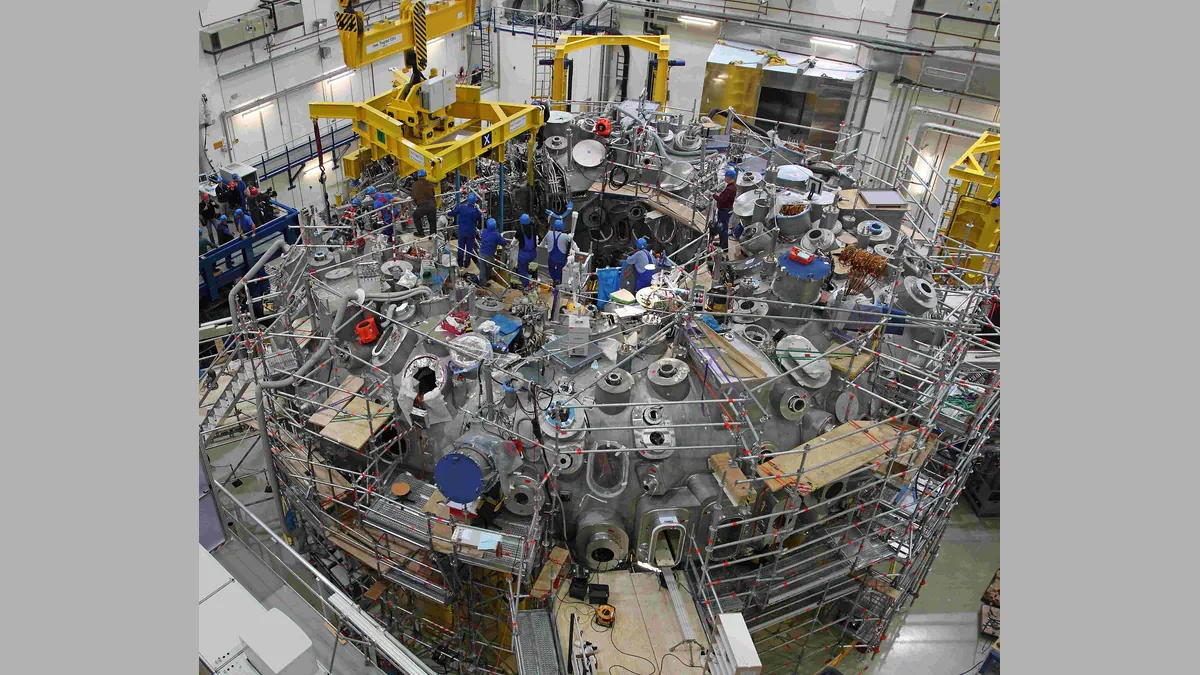
Archive image · Photo: Max-Planck-Institut für Plasmaphysik, Tino Schulz / Wikimedia Commons, CC BY-SA 3.0 (cropped and resized)
The Wendelstein 7-X fusion device at the Max Planck Institute for Plasma Physics (IPP) in Greifswald – the world's largest stellarator – is running again. After the device was ramped up between April and September, a new two-part experimental campaign has begun, the German Press Agency dpa reported on 26 October: the first part runs until 10 December, the second from February to the end of April. Experiments usually take place three days a week; the data will be analysed after the campaign.
More than 600 experiment proposals were submitted for the campaign, and around 250 were given high priority. The focus is on controlling the plasma, which reaches several million degrees, and on the stress on materials. A new record is "no declared goal, but possible", the IPP said. In May 2025, the device reached a record value for its type of facility in the so-called triple product.
The campaign will be followed by a longer maintenance phase until the end of April 2028; new experiments are expected in September 2028. "We will significantly expand and strengthen the microwave heating of Wendelstein 7-X in the coming years," the institute announced. Enough heating power is to be installed by 2029, with the goal of a plasma lasting about half an hour. Wendelstein 7-X is not a power plant itself but is meant to lay the groundwork for future fusion power plants; the German government wants the country's first commercial fusion plant to start operating in the 2040s.