
China's wind giant – how the desert became an energy hub
In the Gobi Desert in Gansu province, China has built the world's largest wind base. Jiuquan shows that turbines are only the start – the grid, transmission and storage are what decide.
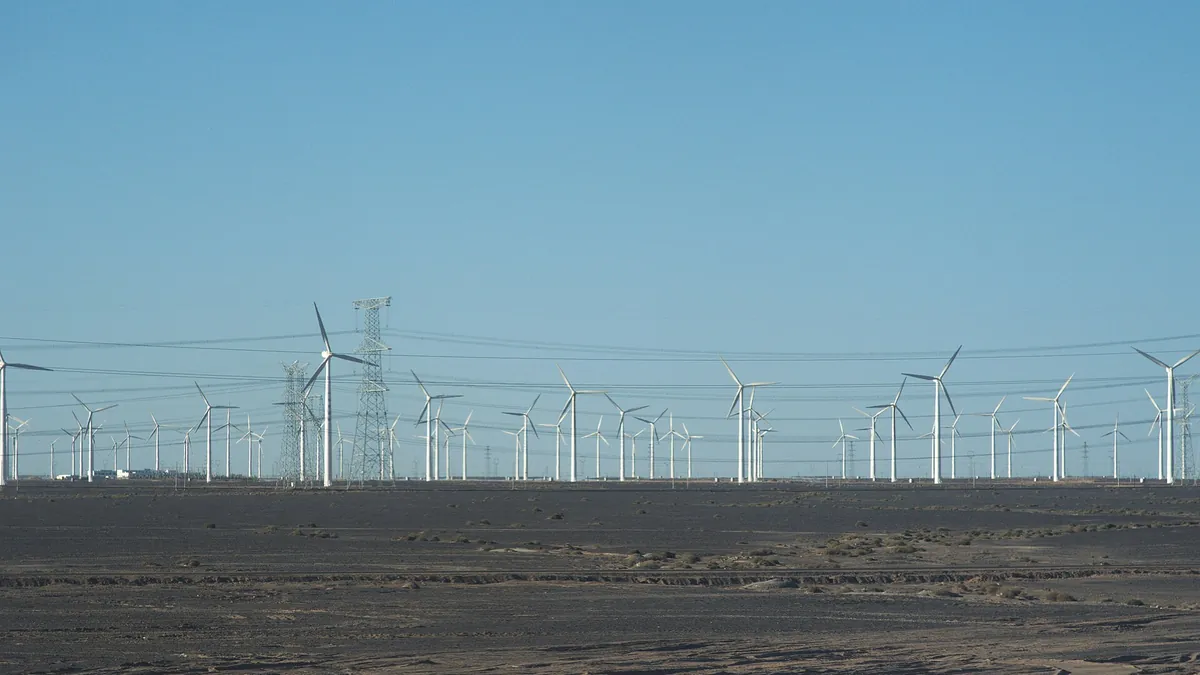
Photo: Popolon / Wikimedia Commons, CC BY-SA 3.0 (cropped and resized)
In north-western China, in Gansu province, lies one of the largest wind energy projects in the world – the Jiuquan Wind Power Base. Located around the city of Jiuquan, amid the vast expanses of the Gobi Desert and neighbouring desert areas, the complex turns the region's strong winds into electricity for millions of consumers.
It is important to note that Jiuquan is not a single wind power plant but a huge complex of many wind farms. It is precisely because of this scale that it is known as the world's largest wind energy base by installed capacity.
Thousands of turbines in the desert
Construction of the complex begins in 2009. The first phase reaches around 5.16 GW of installed capacity and includes more than 3,500 wind turbines. The original plans foresee a gradual expansion of the complex to 20 GW.
Work starts in August 2009, and completion of the first phase is announced in November 2010. Estimates at the time put total investment in the base at around 120 billion yuan (about 17.5 billion dollars), with more than 20 energy companies involved in the project.
The scale is hard to capture in a single number. Individual turbine arrays stretch across hundreds of kilometres, and the vast spaces of the Gobi allow many wind farms to be built within one shared energy zone.
But why here of all places?
When nature becomes an energy resource
The area around Jiuquan, Guazhou and Yumen is among the places with exceptionally good conditions for wind power. Strong and relatively steady winds, huge sparsely populated areas and room for infrastructure make the region a natural location for wind energy. China's National Energy Administration estimates the region's wind development potential at several tens of gigawatts.
In this way, a natural feature – the strong wind – gradually becomes the foundation of an entirely new energy sector.
But there is one big question: how does the electricity reach consumers?
Generating huge amounts of electricity in a remote desert region is only one side of the task.
Gansu lies far from some of China's largest centres of electricity consumption. That is why the development of wind energy goes hand in hand with the construction of powerful transmission infrastructure.
For a long time, however, the grid could not keep pace with construction. According to the National Energy Administration, around 39 per cent of wind power in the Jiuquan area went unused in 2015 – turbines were curtailed because the grid could not absorb the electricity. In 2016 the curtailment rate for wind across Gansu province reached 43 per cent, and turbines ran on average for just 1,088 full-load hours a year.
In 2017 the Jiuquan–Hunan high-voltage line goes into operation. It has a voltage of ±800 kV, is around 2,383 kilometres long and has a rated transmission capacity of 8 GW. Through it, electricity from north-western China is carried to Hunan.
Today, further ultra-high-voltage lines run out of Gansu. The Longdong–Shandong line (±800 kV, 8 GW, 926 km) went into operation in 2025, and the roughly 2,370 km Gansu–Zhejiang line has been under construction since 2024. It is expected to carry more than 36 TWh a year, more than half of it from renewable sources.
This shows one of the most important features of China's approach: it is not just wind turbines that are built, but an entire system around them – generation, grid, transmission and consumption.
From wind farm to energy system
Today the Gansu region is developing not only as a centre for wind energy. Huge solar installations, storage systems and new transmission corridors are being added to the wind capacity.
The figures show the scale of this transition. At the end of 2025, wind and solar capacity in Gansu exceeds 80 GW – more than 64 per cent of all power plant capacity in the province. Jiuquan alone accounts for around 35.7 GW, or 46 per cent of the provincial total. Between 2021 and 2025 the region connected 23 GW of new capacity to the grid and sent more than 150 billion kWh of electricity to other parts of China.
An industry of its own has also grown up around the base: local factories can produce turbines, blades and towers for more than 20 GW of new capacity a year. The local government's goal is to turn Jiuquan into a "world clean energy valley" with capacity on the order of 100 GW.
In this way, the desert areas are gradually becoming energy hubs from which electricity flows to China's industrial and populated regions.
This is perhaps where the most important lesson from Jiuquan lies.
The question is not only how many wind turbines can be built.
The question is whether a country can create all the infrastructure needed for the electricity they generate to be used efficiently.
What does the Chinese example show?
Jiuquan shows that developing renewable energy is not just about building individual wind farms. It takes suitable natural conditions, investment, a transmission grid, storage systems, industry and long-term planning.
And perhaps this is exactly the question we should be asking in Europe too:
Not only how many wind turbines we can build, but how we can create an energy system that uses the electricity they generate as efficiently as possible.
China's wind giant in Gansu is an example of how a place that until recently seemed one of the least suitable for conventional energy production – the desert – can become one of the great energy centres.
Sources
- China Daily – Jiuquan wind power base completes first stage (04.11.2010)
- Wikipedia – Gansu Wind Farm (mit Belegen u. a. Reuters, NYT, SCMP)
- China Energy Portal – Windkraft nach Provinzen 2016 (NEA-Daten)
- Powerline – Inbetriebnahme UHVDC Jiuquan–Hunan (20.03.2017)
- Hitachi Energy – UHVDC Longdong–Shandong
- Enerdata – Baubeginn UHVDC Gansu–Zhejiang (01.08.2024)
- SMM – Gansu: über 80 GW neue Energien Ende 2025
- CNR – Jiuquan im 14. Fünfjahresplan (28.12.2025)
- Xinhua – Gansu: Neue Energien und Windindustrie Jiuquan (20.01.2025)
- Tencent News – Jiuquan „Welttal der sauberen Energie“ (10.07.2025)