
Listening to nuclear waste casks: fibre-optic sensor to detect cracks and rust early
A University of Pittsburgh team has tested a fibre-optic ultrasonic sensor at Idaho National Laboratory that is designed to detect corrosion on steel canisters holding spent nuclear fuel.
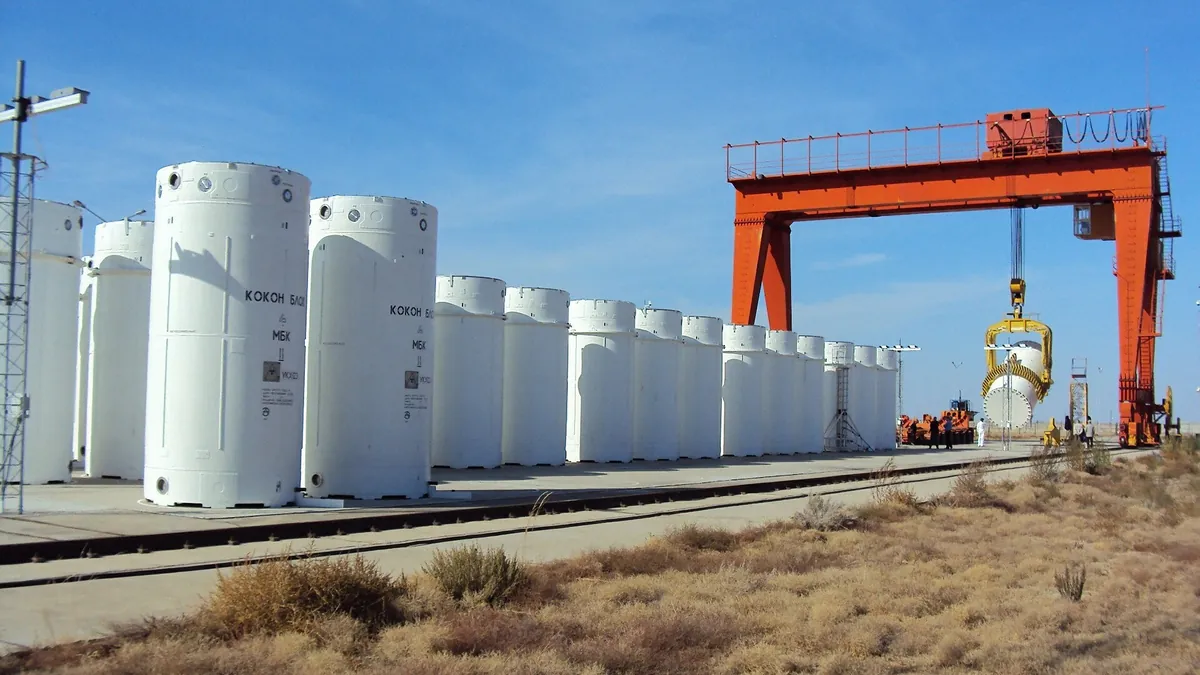
Symbolic image · Photo: Nuclear Regulatory Commission from US / Wikimedia Commons, CC BY 2.0 (cropped and resized)
Spent fuel from nuclear power plants is sealed in steel canisters that can sit inside concrete casks on the plant site for decades. Salty air can enter through vents and attack the steel. Researchers at the University of Pittsburgh's Swanson School of Engineering and the start-up Sensible Photonics, co-founded by Pitt professor Paul Ohodnicki, are developing a fibre-optic ultrasonic sensing system intended to detect corrosion and cracking in these canisters early. The university reported on initial field tests on 14 October.
From 8 to 11 September, the team including Khurram Naeem and Yang-Duan Su tested an early concept at Idaho National Laboratory, deploying optical fibres in several configurations on the outside of a mock canister. According to Naeem, the system detects signals above 100 kilohertz, whereas most conventional counterparts manage 20 kilohertz. In standard pencil-lead-break tests, the team showed that the technology could detect the sound and locate its source. They also tested how the sensors can stay attached to the cask for years under heat and radiation.
The tests complete the first project phase, funded through a small-business technology transfer grant and supported by the US Department of Energy's Office of Nuclear Energy. The team is now seeking further funding for robustness and long-term stability testing and for commercialisation. The release does not cite a peer-reviewed publication.