
Storm surge test: salt marshes withstand even extreme waves surprisingly well
Large-scale test with waves up to 2 metres: salt-marsh plants lose about 30% of their biomass on average, while uprooting stays rare. That matters for natural coastal protection.
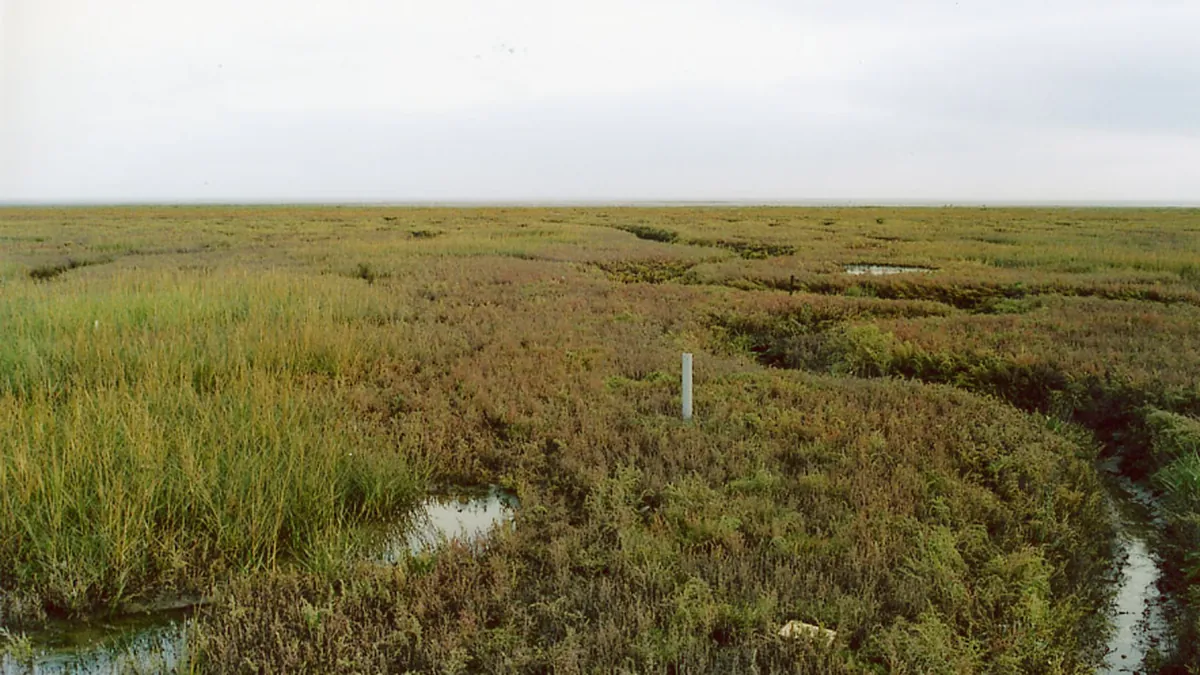
Symbolic image · Photo: Urs Neumeier / Wikimedia Commons, CC BY-SA 2.5 (cropped and resized)
A team led by first author Victoria Mason and coastal ecologist Tjeerd Bouma (Utrecht University) examined whether salt marshes can survive extreme storms, in the journal Communications Sustainability from the Nature group (8 October 2026). The researchers exposed three typical species – common cord-grass, common reed and sea club-rush – to waves up to 2 metres high at a 4-metre water level in the large Delta Flume of the Dutch institute Deltares. It is an experiment with measured data, complemented by a simplified prediction model.
On average, the stands lost around 30% of their above-ground biomass, and no more than 66% even under the most extreme conditions. Loss of whole shoots was 15% or less on every test day except the most extreme one, when cord-grass lost 34%. At least 19 centimetres of canopy remained after every storm for every species, and stiff stems unable to sway broke most often. The authors point to limitations: there were only three pots per species and test day, each species came from one site in the Western Scheldt estuary, and near-bed flow explained only about 9% of the differences in biomass loss.
Salt marshes are considered nature-based coastal protection because their vegetation dampens waves and traps sediment; the authors note that global sea level is rising by around 4.5 millimetres a year on average and that storms may become locally more frequent and intense. Because roots and remaining vegetation survive, the marsh can be expected to recover before the next storm season, they write. Carbon storage in salt marshes can help mitigate climate change, the authors say, although the study did not measure it. More precise on-site measurements of vegetation would improve the predictions, according to the researchers.