
Study: Climate change doubled heat deaths in Belgium during June heatwave
A rapid analysis by Vrije Universiteit Brussel estimates 1,181 heat deaths from 17 to 28 June, 665 of them attributable to climate change. The study has not yet been peer-reviewed.
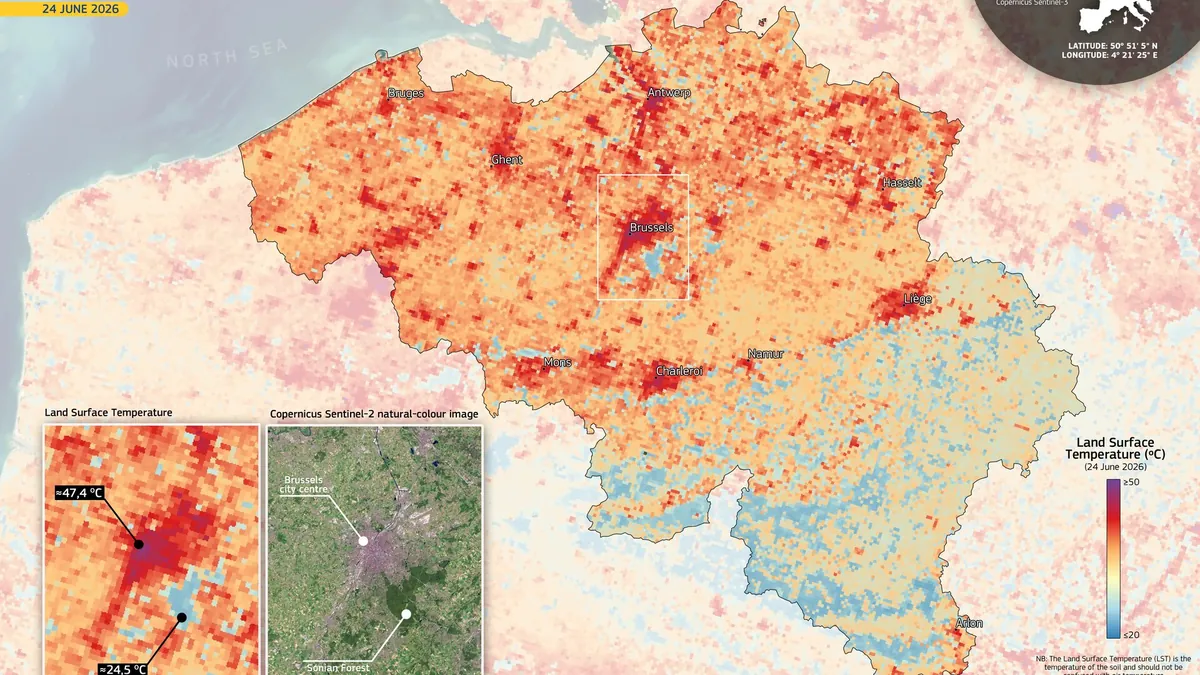
Archive image · Photo: EK - GD DEFIS, EC - DG DEFIS, SPACETEC PARTNERS, Copernicus Sentinel-3 imagery, CE - DG DEFIS / Wikimedia Commons, CC BY 4.0 (cropped and resized)
Climate change roughly doubled the number of heat-related deaths during Belgium's June 2026 heatwave. That is the conclusion of a rapid analysis by Vrije Universiteit Brussel (VUB), published as a report on 16 October and presented on 20 October. For the period from 17 to 28 June, the researchers led by first author Maxim Sleypen and senior author Wim Thiery estimate 1,181 heat-related deaths, about a quarter of all deaths in that period. They attribute 665 of them, or 56 percent, to human-caused climate change. Without it, the calculated toll would have been 516.
The study combines epidemiological models that link daily maximum temperatures to mortality risk with extreme event attribution. According to the analysis, human-induced warming made the twelve hottest days 3.9 degrees warmer. On 26 June, the average daily maximum was an observed 36.0 degrees, compared with a modelled 32.1 degrees without climate change. Uccle recorded 35.5 degrees; on the night of 24 to 25 June, the temperature did not drop below 24.1 degrees, the highest night-time minimum of any Belgian heatwave since 1892. Health institute Sciensano recorded 2,018 excess deaths during and shortly after the heatwave.
The burden was unevenly shared: half of the heat deaths were people aged 85 or older, and women were more affected than men. Liège province had the highest climate-attributable death rate at 9 to 11 per 100,000 inhabitants, followed by Hainaut and Namur at 7 to 9. Importantly, the report has not yet been peer-reviewed, although it relies on established peer-reviewed methods, and results may change slightly. The release gives no uncertainty ranges for the national totals. "Global warming is already costing lives in Belgium today," Sleypen said.