
NASA: Amazon fires spread – satellites miss many blazes burning beneath the canopy
According to NASA Earth Observatory, the eastern Amazon has been burning since September. A satellite analysis finds about 40 percent more fires around Santarém than standard counts show.
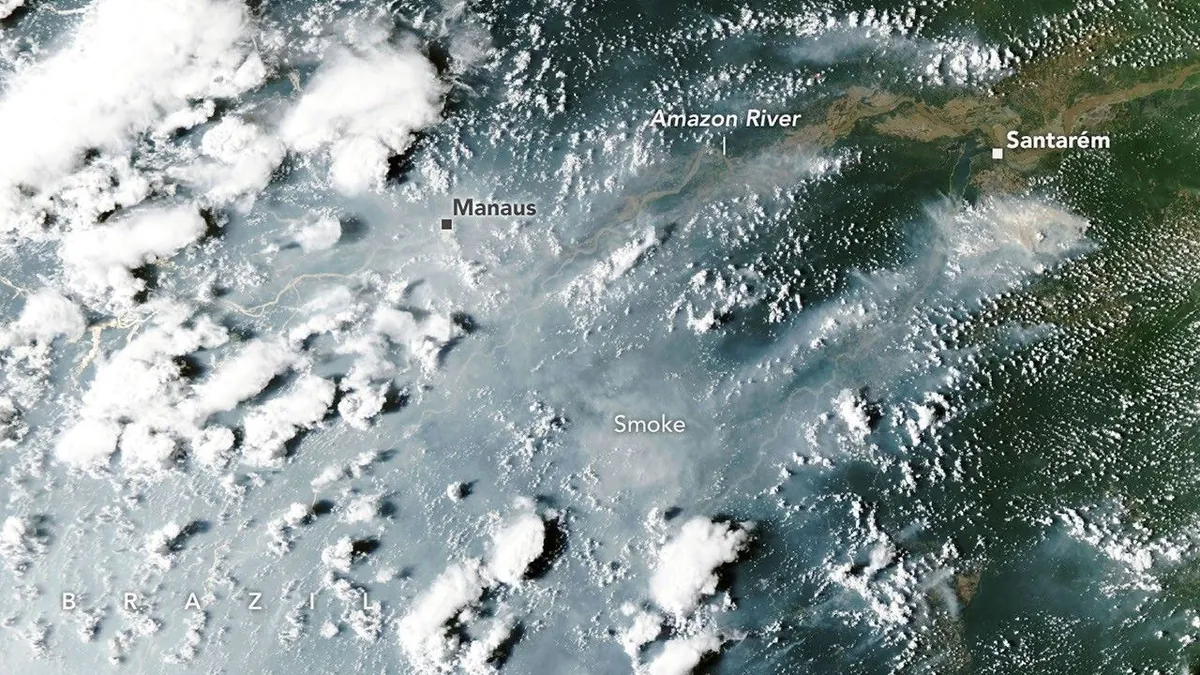
Archive image · Photo: NASA / Wikimedia Commons, Public domain (cropped and resized)
Since September 2026, fires have been spreading across the central and eastern Amazon, from the forests around Manaus and Santarém to the mouth of the Amazon River. That is the finding of a NASA Earth Observatory analysis republished by ScienceDaily on 17 October. In mid-October, Manaus, a city of more than two million people, was shrouded in thick smoke: on 12 October, fine particulate pollution (PM2.5) exceeded 135 micrograms per cubic metre. Schools closed and events were cancelled. According to Brazil's National Institute of Meteorology (INMET), Manaus received 95 percent less rain than normal in August and 60 percent less in September.
NASA points to a combination of drought, the strong El Niño and human activity: lightning causes less than one percent of fires in the humid Amazon. Many large blazes began as controlled burns to clear shrubs or crop residue and then escaped into the forest. Forests that burned in 2015 and 2023 are catching fire again, and trees damaged earlier may be more vulnerable. "Given the intensity of this El Niño, this really is the year for people to avoid burning at all costs," said Douglas Morton of NASA's Goddard Space Flight Center. The analysis does not attribute the current drought to climate change.
The measurements also have a blind spot: satellite instruments such as MODIS and VIIRS detect fires through their heat, but smoke, clouds and dense canopy hide mainly low-intensity understory fires. Shane Coffield (University of Maryland, working at NASA Goddard) searched VIIRS data specifically for such candidates and found about 40 percent more fires around Santarém than the FIRMS fire information system counts; 50 to 70 uncontrolled fires are burning there. NASA does not quantify how much carbon is being released. Researchers expect the fire zone to shift north in November and December.