
NASA: Antarctic sea ice reaches third-lowest winter maximum on record
About 17.59 million square kilometres: Antarctic sea ice grew as little in 2026 as only twice before. After decades of slight growth, it has mostly been below average since 2016.
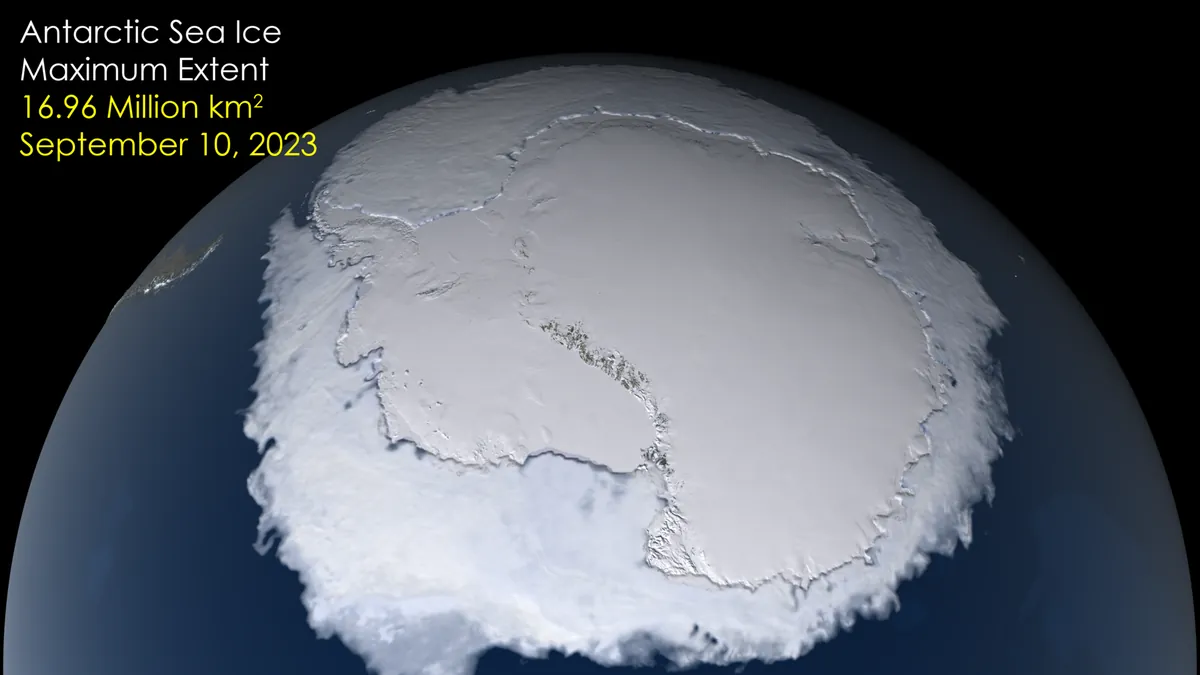
Symbolic image · Photo: NASA's Scientific Visualization Studio - Trent L. Schindler, Grace Weikert, Ian Jones, Laurence Schuler / Wikimedia Commons, Public domain (cropped and resized)
Sea ice around Antarctica probably reached its 2026 winter maximum around 14 September, at about 17.59 million square kilometres. According to NASA and the US National Snow and Ice Data Center (NSIDC), this is the third-lowest winter maximum in the satellite record. NASA’s Earth Observatory summarised the measurements in an analysis that was also published by ScienceDaily on 15 October. The figures are preliminary: because the ice extent fluctuates strongly around the peak, the maximum is hard to confirm, the NSIDC said; it usually occurs in late September or early October, and has come as early as 30 August.
The figures are based on passive microwave sensors on satellites that detect the microwave energy emitted by sea ice – even through clouds. An area counts as ice-covered if at least 15 per cent of the water is covered by ice. The record began in late 1978 with NASA’s Nimbus-7 satellite and has been continued with US military satellites, NASA’s Aqua and, since 2025, Japan’s GCOM-W. NASA and NSIDC give no error range for this year’s value.
Over the long term, the picture in Antarctica has changed: from 1979 to 2014 ice extent grew by about one per cent per decade, although it is unclear whether this was a meaningful trend; 2012 to 2014 saw three record maxima in a row. Since 2016 there have been substantial losses, extent has mostly been below average, and 2023 brought both the lowest summer minimum and the lowest winter maximum. During the 2026 growth season, sea ice “steadily lagged the long-term average”, said NSIDC scientist Ted Scambos. Whether this signals a lasting shift is still being studied; the measurements alone do not explain the causes.