
Satellite study: 86% of 590 Alpine peatlands disturbed – carbon stores under pressure
Roads, ditches, farming, encroaching forest: the vast majority of peatlands studied in the Alps show traces of human interference, according to a study from Brno, Göttingen and Amsterdam.
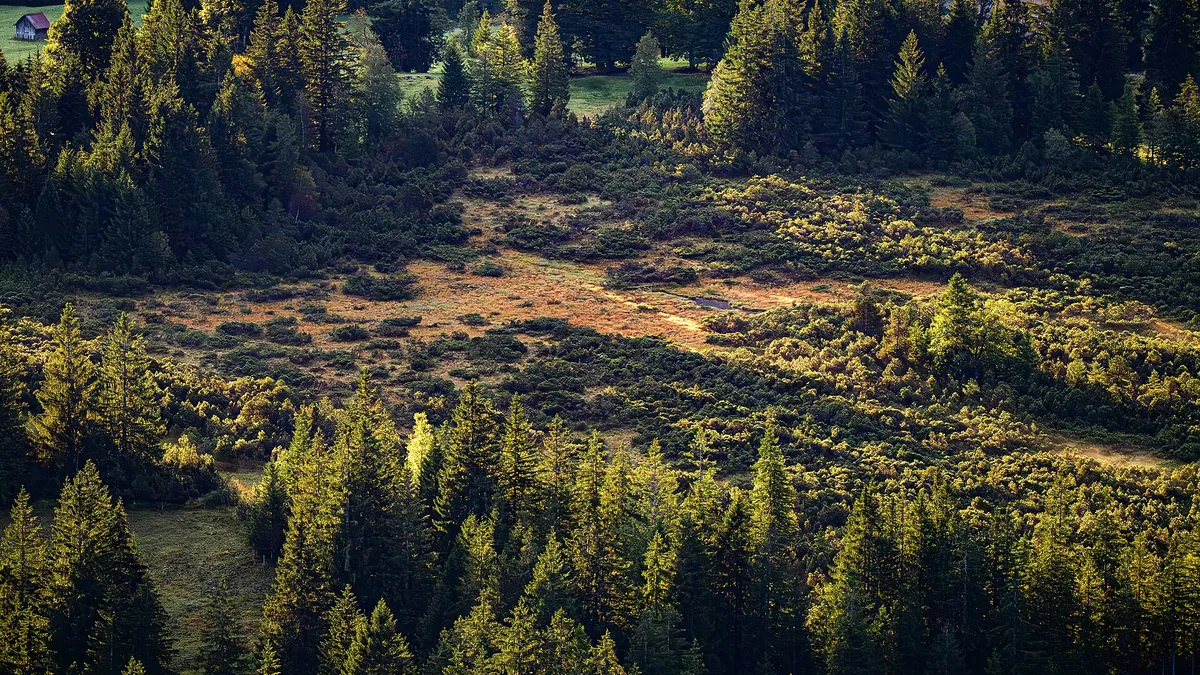
Symbolic image · Photo: Stephan Sprinz / Wikimedia Commons, CC BY 4.0 (cropped and resized)
Researchers led by Marian Schönauer of Mendel University in Brno, Czech Republic, have assessed the condition of peatlands in the Alps using satellite data. The study was published in the journal Communications Earth & Environment; the University of Göttingen and Vrije Universiteit Amsterdam were among the partners. The team combined radar data from the Sentinel-1 satellites, optical data from Sentinel-2 and surface temperatures from Landsat-8 for 2019 to 2023 with terrain data. The detection model was trained on 590 reference peatlands from official inventories in Austria, Germany and Switzerland, and discrepancies with official maps were checked against aerial photographs.
The result: 86 per cent of the 590 reference peatlands show visible disturbance. Roads or buildings were found at 59 per cent, drainage ditches at 46 per cent and agricultural use at 27 per cent. Forest is encroaching on more than a third of the mapped area, and almost half of the sites face several pressures at once. Official inventories are often outdated and compiled differently in each country; some peatlands did not appear in any of them. This is a model-based analysis of satellite data with uncertainties; the best model (based on Sentinel-2) produced “reasonable” results overall; the report gives no accuracy figures. Many Alpine peatlands are smaller than one hectare and therefore hard to monitor.
Peatlands are regarded as long-term carbon stores: their slowly growing layers of dead plant material have locked away carbon from the atmosphere over long periods. According to Simon Drollinger of the University of Göttingen’s bioclimatology group, Alpine peatlands also regulate the water cycle; up-to-date data are crucial for planning targeted conservation and restoration. The study did not measure how much carbon the disturbed peatlands have already lost or are emitting. According to the report, the method could also be applied to mountain peatlands in the Andes and on the Qinghai-Tibet Plateau.